This article is for educational and informational purposes only and is not investment advice. The views expressed are those of the author and do not constitute recommendations to buy, sell, or hold any securities or financial instruments.
I’ve spent the last two decades watching artificial intelligence evolve from academic curiosity to business necessity. But what I’m seeing in early 2026 feels different—not just incremental progress, but a fundamental shift in how financial institutions operate.
The shift has a name: agentic AI.
While most of us were debating whether ChatGPT would replace knowledge workers, a quieter revolution was taking shape in the back offices of banks, trading desks, and compliance departments. AI systems weren’t just answering questions anymore—they were making decisions, executing multi-step workflows, and operating with a level of autonomy that would have seemed like science fiction just 18 months ago.
Wells Fargo is piloting autonomous agents for compliance investigations. Coinbase launched “agentic wallets” that give AI systems the ability to execute financial transactions independently. QuantConnect is integrating AI agents that can research, backtest, and deploy trading strategies without human intervention.
This isn’t hype. This is happening now. And it’s reshaping the competitive landscape of finance faster than most people realize.

What Makes Agentic AI Different
Let’s start with what agentic AI actually is, because the term gets thrown around loosely.
Traditional AI—even sophisticated large language models like GPT-4—operates in a reactive mode. You ask a question, it provides an answer. You give it a task, it completes that specific task. The interaction is fundamentally transactional: input → processing → output.
Agentic AI breaks this pattern. These systems can:
- Set and pursue goals autonomously across multiple steps
- Make decisions about which actions to take next based on context
- Use tools and APIs to interact with external systems
- Learn and adapt their strategies based on outcomes
- Coordinate with other agents in multi-agent workflows
Think of it this way: If traditional AI is a calculator that solves the problem you give it, agentic AI is more like a junior analyst who can figure out what problems need solving, gather the necessary data, run the analysis, and present recommendations—all without constant supervision.
The technical foundation enabling this shift is fascinating. At Savanti Investments, we’ve been tracking three key enablers:
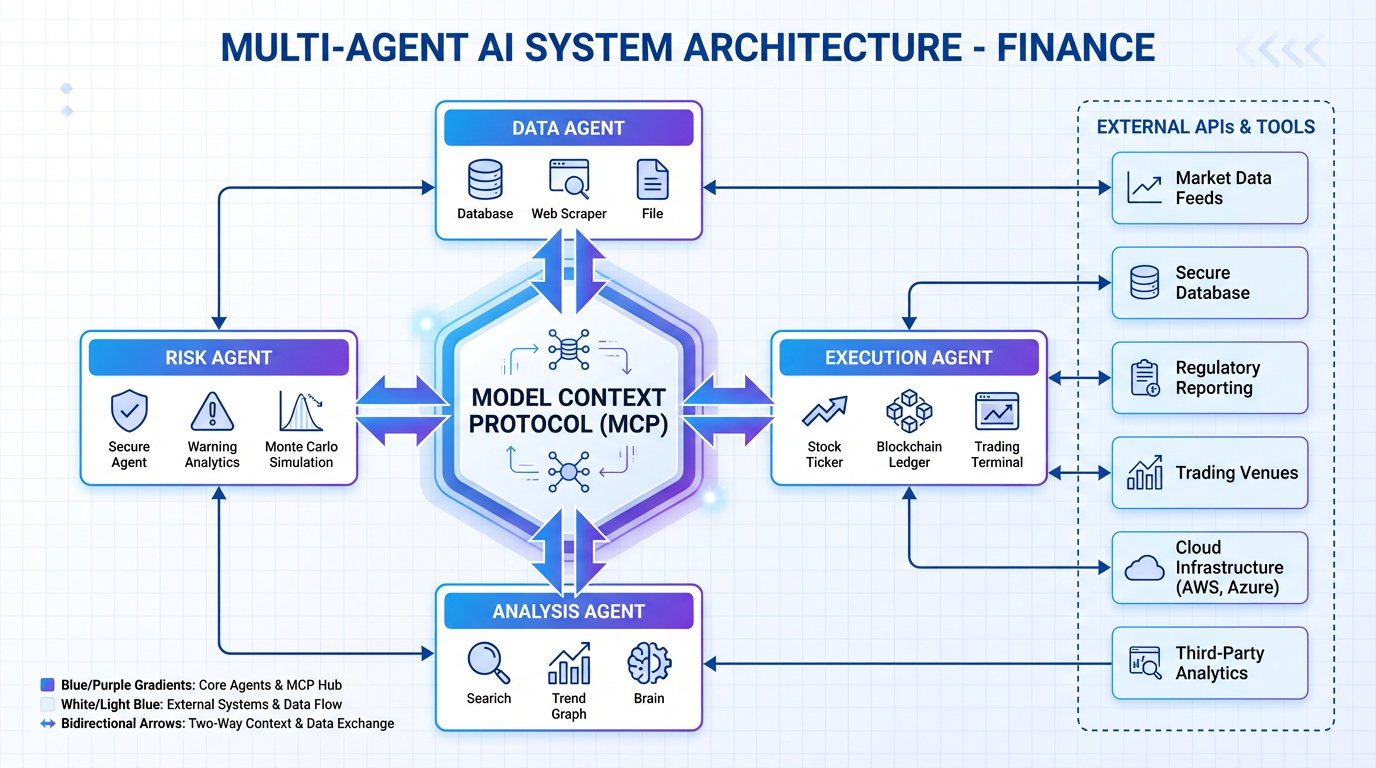
1. The Model Context Protocol (MCP)
Anthropic’s Model Context Protocol has become what industry insiders are calling “USB-C for AI.” It’s a standardized way for AI agents to connect to external tools, databases, and APIs. OpenAI, Microsoft, and Google have all adopted it, creating a universal interface that lets AI agents interact with the broader digital ecosystem.
The analogy is apt: Just as USB-C eliminated the chaos of proprietary charging cables, MCP is eliminating the fragmentation that previously made it difficult for AI systems to reliably interact with enterprise software, trading platforms, and data sources.
2. Multi-Agent Architectures
Rather than building one massive AI system that tries to do everything, the cutting edge involves creating specialized agents that work together. One agent might focus on data gathering, another on analysis, a third on risk assessment, and a fourth on execution.
This mirrors how human organizations work—and it’s proving far more effective than monolithic approaches. Each agent can be optimized for its specific role, and the system as a whole becomes more robust because no single point of failure can bring down the entire operation.
3. Reinforcement Learning from Human Feedback (RLHF)
The breakthrough that made ChatGPT so impressive—training AI systems based on human preferences—is now being applied to agentic workflows. These systems learn not just from data, but from observing how human experts make decisions in complex, multi-step scenarios.
From Pilot Programs to Production: What’s Happening Now
The transition from research labs to real-world deployment is accelerating. Here’s what caught my attention in recent weeks:
Wells Fargo’s Compliance Revolution
Wells Fargo isn’t just experimenting with agentic AI—they’re deploying it for some of their most critical operations. The bank is piloting autonomous agents for customer operations and, more significantly, for compliance, anti-money laundering (AML), and fraud investigations.
The implications are profound. Compliance has traditionally been one of the most labor-intensive, expensive parts of banking. Human analysts review transactions, investigate suspicious patterns, and prepare reports for regulators. It’s meticulous work that requires both attention to detail and contextual judgment.
Agentic AI systems can now handle the initial triage autonomously—flagging suspicious activity, gathering relevant transaction history, cross-referencing against known patterns, and escalating only the most complex cases to human teams. Early results suggest this could reduce compliance costs significantly while actually improving detection rates.
Coinbase’s Agentic Wallets
Coinbase’s launch of “agentic wallets” represents a different kind of breakthrough: giving AI systems the ability to execute financial transactions autonomously.
This might sound alarming at first—autonomous AI with access to money? But the implementation is more nuanced. These wallets operate within strict parameters and guardrails, enabling use cases like:
- Automated rebalancing of crypto portfolios based on predefined strategies
- Execution of complex DeFi strategies that require multiple sequential transactions
- Programmatic responses to market conditions (e.g., moving assets to stablecoins when volatility exceeds thresholds)
The key innovation isn’t just the automation—it’s the trustless nature of the execution. Smart contracts and blockchain transparency mean these agents operate in a verifiable, auditable way.
The Quant Trading Revolution
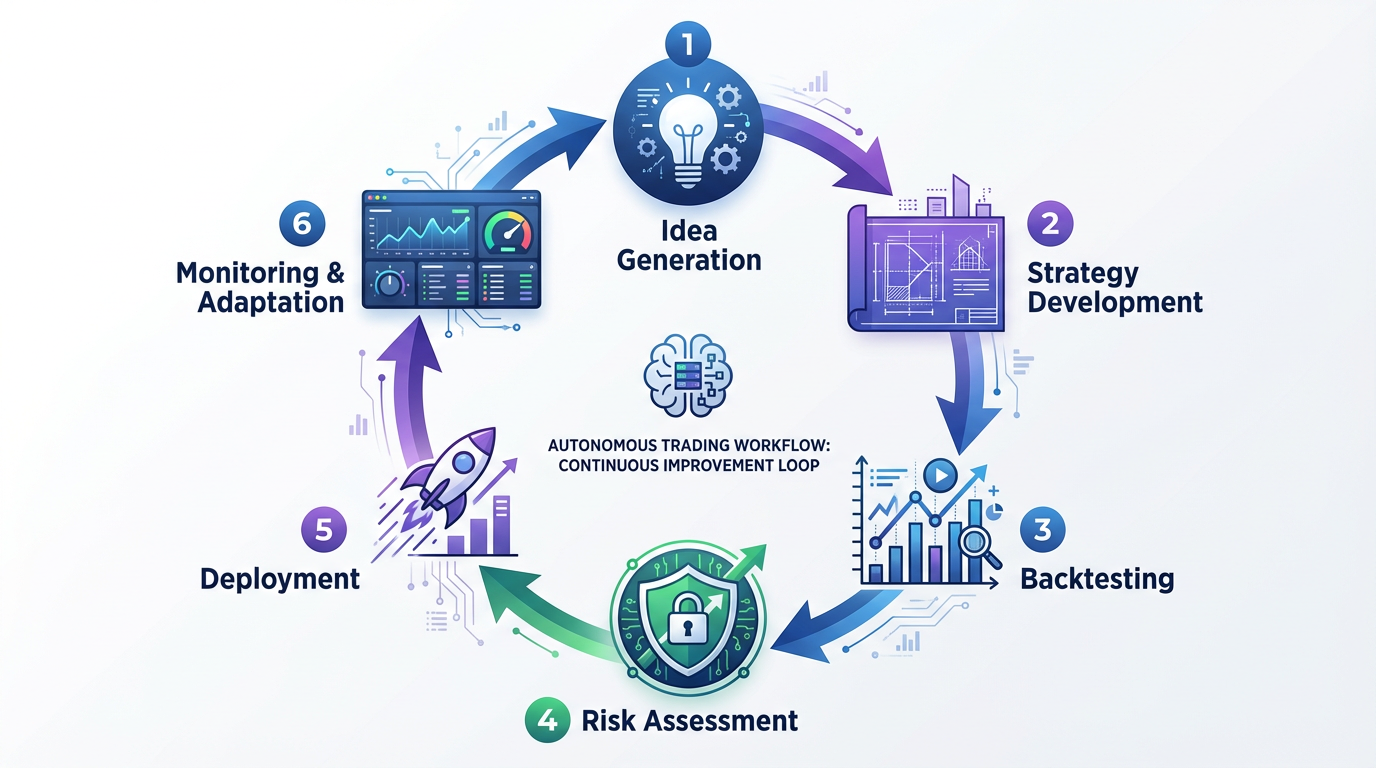
Perhaps nowhere is agentic AI having more immediate impact than in quantitative trading. Platforms like QuantConnect are integrating what they call “Quant 2.0″—AI agents that can handle the entire trading workflow.
Here’s what that looks like in practice:
- Idea Generation: The agent scans market data, news, and alternative data sources to identify potential trading opportunities
- Strategy Development: It formulates hypotheses about market behavior and designs strategies to exploit them
- Backtesting: The agent tests strategies against historical data, iterating and refining based on results
- Risk Assessment: It evaluates potential drawdowns, correlation risks, and capital requirements
- Deployment: If the strategy meets predefined criteria, the agent can deploy it to live trading
- Monitoring & Adaptation: The agent continuously monitors performance and adjusts parameters in response to changing market conditions
This isn’t theoretical. QuantInsti reports that platforms using agentic AI for trading are seeing dramatic improvements in strategy development speed—what used to take weeks of human analyst time now happens in hours or days.
At Savanti, our QuantAI™ platform has been exploring similar territory. We’re seeing that the real value isn’t just speed—it’s the ability to test and iterate through far more strategy variations than human teams could ever evaluate. The AI doesn’t get tired, doesn’t have cognitive biases, and can simultaneously explore multiple hypotheses.
The Broader Financial Services Transformation
Beyond these headline-grabbing deployments, agentic AI is quietly transforming other corners of finance:
Risk Management
Traditional risk management relies on rule-based systems and periodic human review. Agentic AI enables something more dynamic: autonomous risk engines that continuously monitor portfolios, market conditions, and external signals, adjusting controls in real-time.
Machine learning models analyze transactional data, customer behavior, and external signals to detect fraud and money laundering patterns that rule-based systems miss. By 2026, we’re seeing compliance shift from reactive to proactive—AI agents flag potential issues before they become problems.
Customer Operations
The customer service chatbot has evolved. Modern agentic systems can handle complex, multi-step customer requests that previously required human agents:
- Investigating and resolving account discrepancies
- Processing loan applications end-to-end
- Providing personalized financial advice based on comprehensive account analysis
- Identifying and preventing fraud in real-time during customer interactions
Younger consumers—particularly Gen Z and Millennials—are increasingly comfortable with AI handling these interactions. They value speed and convenience over human touch for routine transactions.
The “AI-ification” of the CFO Role
One of the more intriguing developments is what some are calling the transformation of the CFO function from a “system of record” to a “system of intelligence.”
Autonomous agents are taking over routine compliance tasks—risk flagging, report drafting, regulatory filing preparation. This frees human CFOs and their teams to focus on strategic decision-making, capital allocation, and business partnership.
The cost implications are significant. Compliance costs at major financial institutions run into hundreds of millions annually. Even modest automation can generate substantial savings.
The Infrastructure Layer: What Makes This Possible
None of this happens without robust infrastructure. Three elements are proving critical:
Real-Time Data Activation
Agentic AI requires the ability to collect, process, and act on customer signals within milliseconds. This means:
- Behavioral trigger campaigns that respond instantly to user actions
- Dynamic audience segmentation that updates in real-time
- Cross-channel orchestration that maintains context across touchpoints
- Live personalization that adapts content on the fly
Organizations that have invested in unified data platforms and Customer Data Platforms (CDPs) are seeing 80% reductions in data integration time and 15x faster deployment of new capabilities.
Cloud-Native, API-First Architecture
The shift to composable, microservices-based infrastructure is accelerating. Agentic AI systems need to orchestrate multiple services, and rigid, monolithic architectures simply can’t support that level of flexibility.
This is why we built SavantTrade™ on a cloud-native foundation from day one. The ability to rapidly integrate new data sources, deploy new models, and scale compute resources on demand isn’t optional—it’s foundational.
Privacy-Preserving Technologies
As AI agents gain more autonomy, privacy and security become even more critical. We’re seeing rapid adoption of:
- Federated learning (training models without centralizing sensitive data)
- Differential privacy (adding mathematical noise to protect individual records)
- Secure multi-party computation (enabling analysis across organizations without sharing raw data)
- Homomorphic encryption (performing computations on encrypted data)
These aren’t just compliance checkboxes—they’re competitive advantages. Institutions that can demonstrate robust privacy protections will win customer trust and regulatory approval.
The Challenges We’re Not Talking About Enough
I’d be remiss if I painted this as all upside. There are real challenges and risks that the industry needs to address:
The “Black Swan” Problem
Agentic AI systems learn from historical data and patterns. But financial markets are characterized by rare, high-impact events that don’t fit historical patterns—the 2008 financial crisis, the COVID-19 market crash, the 2010 Flash Crash.
How do autonomous agents handle situations they’ve never seen before? The honest answer is: we don’t fully know yet. This is why human oversight remains critical, especially for high-stakes decisions.
Regulatory Uncertainty
Regulators are playing catch-up. The SEC under Chair Paul Atkins has signaled a more innovation-friendly approach, but fundamental questions remain:
- Who is liable when an autonomous agent makes a bad decision?
- How do we audit AI systems that continuously learn and adapt?
- What disclosure requirements should apply to AI-driven trading?
- How do we prevent AI agents from inadvertently manipulating markets?
The shift from “regulation by enforcement” to proactive guidance is welcome, but we need clearer frameworks.
The Explainability Challenge
Modern AI systems—particularly those using deep learning—often operate as “black boxes.” They make accurate predictions, but explaining why they made a particular decision can be difficult or impossible.
This creates problems in regulated industries where you need to justify decisions to auditors, regulators, and customers. The industry is investing heavily in “explainable AI” techniques, but it remains an active area of research.
Concentration Risk
As more institutions adopt similar AI systems trained on similar data, there’s a risk of herding behavior. If every trading algorithm responds to market signals in similar ways, it could amplify volatility rather than dampen it.
This is one reason why at Savanti, we emphasize proprietary data sources and custom model architectures. Differentiation matters—not just for alpha generation, but for systemic stability.
What This Means for Investors and Entrepreneurs
So where does this leave us? A few observations:
For Investors
1. Infrastructure plays matter more than ever. The companies building the picks and shovels for agentic AI—data platforms, API infrastructure, security tools—are seeing explosive growth. This is where we’re seeing some of the most compelling investment opportunities.
2. The competitive moat is shifting. Traditional advantages like brand and distribution still matter, but the ability to deploy AI effectively is becoming a primary differentiator. Companies that can’t keep pace will find themselves at a structural disadvantage.
3. Regulatory risk is real but manageable. The institutions that engage proactively with regulators, build robust governance frameworks, and prioritize transparency will navigate this transition successfully. Those that move fast and break things will face consequences.
For Entrepreneurs
1. The opportunity is in vertical integration. General-purpose AI tools are commoditizing. The value is in building agentic systems tailored to specific workflows in specific industries. Deep domain expertise combined with AI capabilities is the winning formula.
2. Start with compliance and risk. These are areas where institutions have clear ROI, regulatory pressure to improve, and willingness to pay. It’s easier to sell cost savings and risk reduction than speculative alpha generation.
3. Build for auditability from day one. The ability to explain, audit, and govern AI decisions isn’t optional—it’s table stakes. Systems that can’t demonstrate robust governance won’t get past procurement, no matter how impressive their capabilities.
For Financial Professionals
The question I get most often: “Will AI replace me?”
The honest answer is: it depends on what you do.
If your value comes from executing routine tasks—processing transactions, running standard reports, following predefined procedures—yes, agentic AI will likely automate much of that work.
But if your value comes from judgment, relationship management, strategic thinking, and handling novel situations, you’re not being replaced—you’re being augmented. The most successful professionals will be those who learn to work with AI agents, using them to handle routine work while focusing their own efforts on high-value activities.
IBM’s announcement that they’re tripling entry-level hiring while deploying more AI is instructive. They’re redesigning roles to focus on higher-value tasks augmented by AI, not eliminating roles entirely.
The key is developing what some are calling “AI fluency”—understanding what AI can and can’t do, how to prompt and guide it effectively, and how to validate its outputs. This is becoming a core skill, like Excel proficiency was for the previous generation.
Looking Ahead: The Next 12-24 Months
Where is this heading? A few predictions:
1. Consolidation in the AI tooling space. There are too many point solutions chasing the same opportunities. We’ll see M&A activity accelerate as larger players acquire specialized capabilities and smaller players struggle to achieve scale.
2. The emergence of “AI discipline.” Regulators are shifting from guidance to enforcement. 2026 will be the year when firms need to demonstrate not just that they use AI, but that they use it responsibly, with proper governance and controls.
3. Agentic AI moves beyond finance. What we’re seeing in financial services is a preview of what’s coming to healthcare, legal services, supply chain management, and other knowledge-intensive industries. The patterns and lessons learned in finance will inform these other sectors.
4. The rise of “super-app” platforms. The SEC has signaled openness to platforms that can offer trading in crypto assets, traditional securities, staking services, and more under a single license. Agentic AI will be the glue that makes these integrated experiences possible.
5. Quantum computing enters the conversation. While still early, quantum computing is transitioning from labs to boardrooms. By late 2026 or early 2027, we’ll start seeing the first quantum-enhanced AI systems for risk modeling and portfolio optimization.
The Bottom Line
Agentic AI represents a fundamental shift in how financial institutions operate—not just an incremental improvement in efficiency, but a reimagining of what’s possible when AI systems can act autonomously within defined parameters.
The institutions that embrace this shift thoughtfully—investing in infrastructure, building governance frameworks, and developing AI fluency across their organizations—will gain significant competitive advantages. Those that wait will find themselves playing catch-up in an increasingly AI-native industry.
At Savanti Investments, we’re not just observing this transformation—we’re actively participating in it. Our QuantAI™ and SavantTrade™ platforms are built on the premise that the future of investing is a collaboration between human judgment and AI capabilities, each amplifying the other’s strengths.
The question isn’t whether agentic AI will reshape finance. It’s already happening. The question is whether you’re positioned to benefit from it.
The autonomous agents are here. The question is: are you ready?