We’re living through one of those rare moments when the rules of the game fundamentally change. I’ve spent the better part of two decades building systems that make decisions—first in quantitative finance, now across the broader AI landscape—and I can tell you with certainty: 2026 is the year autonomous AI agents moved from “interesting experiment” to “mission-critical infrastructure.”
But here’s the paradox that keeps me up at night: the very autonomy that makes these agents so powerful is also what makes them so dangerous. And most organizations are woefully unprepared for what’s coming.

The Autonomous Revolution Is Already Here
Let’s start with some context. The enterprise AI agent market isn’t just growing—it’s exploding. We’re looking at an $11 billion market in 2026, projected to surpass $200 billion by the mid-2030s. That’s a compound annual growth rate approaching 50%. To put that in perspective, this is faster than the early days of cloud computing.
And it’s not hype. Real companies are seeing real returns. Danfoss automated their purchase order decisions and saved $15 million annually. Telus deployed AI agents and freed up 38,000 employee hours every month. IBM is reporting billions in savings. The ROI analysis I’ve seen shows 405% returns over three years with payback periods under five months.
At Savanti Investments, we’ve been on the bleeding edge of this transition. Our QuantAI™ platform has evolved from sophisticated algorithmic trading to what I now call “agentic finance”—autonomous systems that don’t just execute trades, but actively monitor markets, identify opportunities, assess risks, and make decisions across multiple asset classes simultaneously. The performance gains have been remarkable, but so have the governance challenges.
From Single Agents to Orchestrated Intelligence
Here’s what most people miss: we’re not just talking about smarter chatbots. The architectural shift happening right now is profound. The industry is moving from monolithic, single-agent systems to sophisticated multi-agent systems (MAS)—what some are calling the “microservices moment” for AI.

Think about it this way: instead of one massive AI trying to do everything (and inevitably failing at most things), you have a team of specialized agents, each optimized for specific functions, collaborating to solve complex problems. One agent handles planning, another executes, a third evaluates outcomes, and they all communicate through standardized protocols.
This is exactly the approach we’ve taken with SavantTrade™. Rather than a single monolithic system, we orchestrate multiple specialized agents: market analysis agents, risk assessment agents, execution agents, and compliance monitoring agents. Each operates autonomously within its domain, but they coordinate through a central orchestration layer that ensures alignment with our overall investment strategy.
The technical infrastructure enabling this is maturing rapidly. Frameworks like Microsoft’s AutoGen, CrewAI, and LangGraph provide the scaffolding. Standardized protocols like Anthropic’s Model Context Protocol (MCP) and Google’s Agent-to-Agent Protocol (A2A) are creating interoperability. Deloitte predicts that by the end of 2026, two or three dominant protocols will emerge, creating a true marketplace of interoperable agent services.
The Governance Gap: Our Biggest Vulnerability
But here’s where it gets uncomfortable. The same autonomy that drives value also introduces unprecedented risk. An agent that can independently access systems, process sensitive data, and execute actions without human approval can also make catastrophic mistakes—or be exploited by malicious actors.
I’ve seen this firsthand. Early versions of our trading agents occasionally made decisions that, while technically correct based on their training, violated our risk parameters in edge cases we hadn’t anticipated. One agent nearly deleted a critical codebase during a routine optimization task. Another mishandled confidential client data during a system integration. These weren’t theoretical risks—they were real incidents that could have caused serious harm.
The industry is waking up to this reality. A recent MIT report found that 95% of AI initiatives fail to reach production, and the primary reason isn’t technological capability—it’s architectural and governance gaps. As one security expert put it: “The bottleneck of agentic AI deployments is no longer capability, but security and guardrails.”
The First Governance Frameworks Emerge
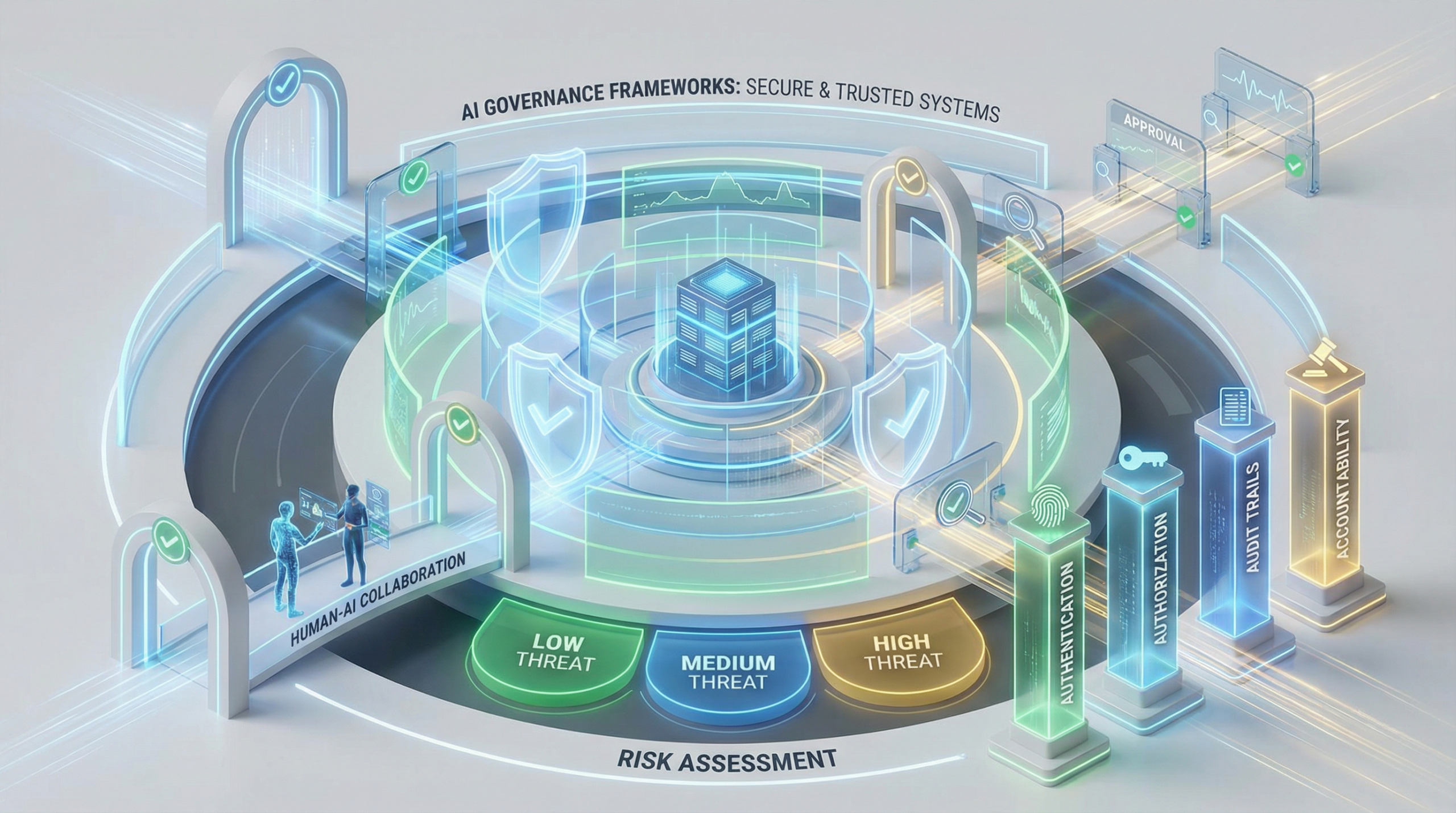
The good news? 2026 has seen the emergence of the world’s first dedicated governance frameworks for agentic AI, and they’re remarkably practical.
In January, Singapore’s Infocomm Media Development Authority launched the Model AI Governance Framework for Agentic AI (MGF). It’s built on four pillars:
- Risk Assessment and Bounding: Before deployment, rigorously assess and limit an agent’s “action-space”—what it can and cannot do.
- Human Accountability: Ensure meaningful human oversight at critical checkpoints, not just rubber-stamp approvals.
- Technical Controls: Implement robust safety and reliability measures throughout the agent’s lifecycle.
- End-User Responsibility: Promote transparency and training so users understand what they’re interacting with.
Then in February, the Cloud Security Alliance published the Agentic Trust Framework (ATF), which applies Zero Trust principles to AI agents. The core premise: no agent should be trusted by default. Every action requires continuous verification across five elements: Identity (who is the agent?), Behavior (what is it doing?), Data Governance (what data can it access?), Segmentation (where can it operate?), and Incident Response (what happens if it goes rogue?).
What I find particularly elegant about the ATF is its maturity model. Agents start as “Interns” with minimal autonomy and earn greater privileges—progressing to “Associate,” “Senior,” and eventually “Principal”—by demonstrating trustworthiness over time. It’s exactly how we think about human employees, applied to autonomous systems.
Real-World Implications Across Industries
The applications are already transforming entire industries. In customer support, agents are handling 80% of routine inquiries autonomously. In supply chain management, multi-agent systems are monitoring inventory, predicting demand shifts, and rerouting shipments in real-time. In cybersecurity, agents provide continuous protection by detecting anomalies, isolating compromised systems, and deploying fixes faster than any human team could.
In financial services—my world—the impact is particularly profound. Agents monitor transactions for fraud, validate regulatory compliance, automate accounts payable, and provide real-time cash flow insights. They’re not replacing human judgment; they’re augmenting it, handling the high-volume, time-sensitive decisions while escalating complex edge cases to human experts.
At Convirtio, our marketing automation platform, we’re seeing similar patterns. AI agents now manage entire campaign lifecycles: scoring leads, triggering personalized outreach, optimizing budgets based on real-time performance, and even A/B testing creative variations. The agents operate autonomously within guardrails we’ve defined, but they’re constantly learning and adapting in ways that would be impossible with traditional rule-based automation.

The Regulatory Landscape Is Evolving Fast
Of course, regulation is racing to catch up. The EU AI Act, now fully enforceable, explicitly mandates “effective human oversight” for high-risk AI systems—a category that many enterprise agents fall into. Organizations deploying agents in employment decisions, critical infrastructure, or safety-critical applications must ensure compliance with stringent requirements for transparency, robustness, and accuracy.
In the U.S., we’re seeing a patchwork of state-level legislation. Colorado’s AI Act and Texas’s Responsible AI Governance Act establish duties of care for developers and deployers of high-risk systems. And beyond AI-specific laws, agents must comply with subject-matter regulations in finance, healthcare, employment, and consumer protection.
The smart move? Don’t wait for regulation to force your hand. Build governance into your architecture from day one. Document everything: risk assessments, policies, technical logs, oversight mechanisms. Establish clear human-in-the-loop (HITL) protocols for high-risk actions and human-on-the-loop (HOTL) monitoring for lower-risk autonomous operations. Apply the principle of least privilege to data access. Make compliance a design requirement, not an afterthought.
Looking Ahead: The Governance Advantage
Here’s my prediction: over the next 24 months, the competitive advantage in AI won’t come from having the most sophisticated models or the largest training datasets. It will come from having the most robust governance frameworks.
The organizations that figure out how to safely deploy autonomous agents at scale—with proper oversight, security, and accountability—will dominate their industries. Those that don’t will either fail to deploy at all (missing the efficiency gains) or deploy recklessly (and face catastrophic failures, regulatory penalties, or security breaches).
We’re also going to see a new ecosystem emerge. At the foundation, hyperscalers will provide the models and infrastructure. In the middle, established enterprise software vendors will embed agentic capabilities into existing platforms. But the real disruption will come from “agent-native” startups building products from the ground up with an agent-first architecture, unconstrained by legacy systems.
The most advanced organizations are already moving beyond simple HITL approval gates to sophisticated HOTL orchestration, where agents operate with significant autonomy under strategic human supervision. This frees human experts to focus on exception handling and high-value strategic decisions rather than routine approvals.
The Bottom Line
Autonomous AI agents represent one of the most significant technological shifts of our generation. The potential for efficiency, innovation, and competitive advantage is enormous. But so are the risks.
The organizations that will thrive in this new era aren’t those with the most advanced AI—they’re those with the wisdom to govern it properly. They understand that autonomy without accountability is recklessness, and that the path to sustainable AI advantage runs through robust governance frameworks.
At Savanti, we’ve learned this lesson the hard way. Building QuantAI™ and SavantTrade™ taught us that the technology is the easy part. The hard part is creating the organizational structures, technical controls, and cultural norms that allow autonomous systems to operate safely at scale.
The rise of agentic governance isn’t a constraint on innovation—it’s the foundation that makes innovation sustainable. And in 2026, that’s the competitive advantage that matters most.