Disclaimer: This article is for educational and informational purposes only and is not investment advice. The information provided does not constitute a recommendation to buy, sell, or hold any security or financial product. Please consult with a qualified financial advisor before making any investment decisions.
The Future of Finance Is Already Here—And It’s Autonomous
I remember the first time I saw a trading algorithm execute a complex multi-leg options strategy in milliseconds. It was 2015, and I was sitting in a hedge fund’s trading room, watching screens flash with orders that no human hand had touched. At the time, it felt like science fiction. Today, that level of automation is table stakes. What’s happening now makes those early algorithms look like pocket calculators.
We’re entering the era of Agentic Finance—a paradigm where artificial intelligence doesn’t just assist financial decisions, it makes them. Autonomously. At scale. And increasingly, on blockchain rails that make every action transparent, immutable, and verifiable.
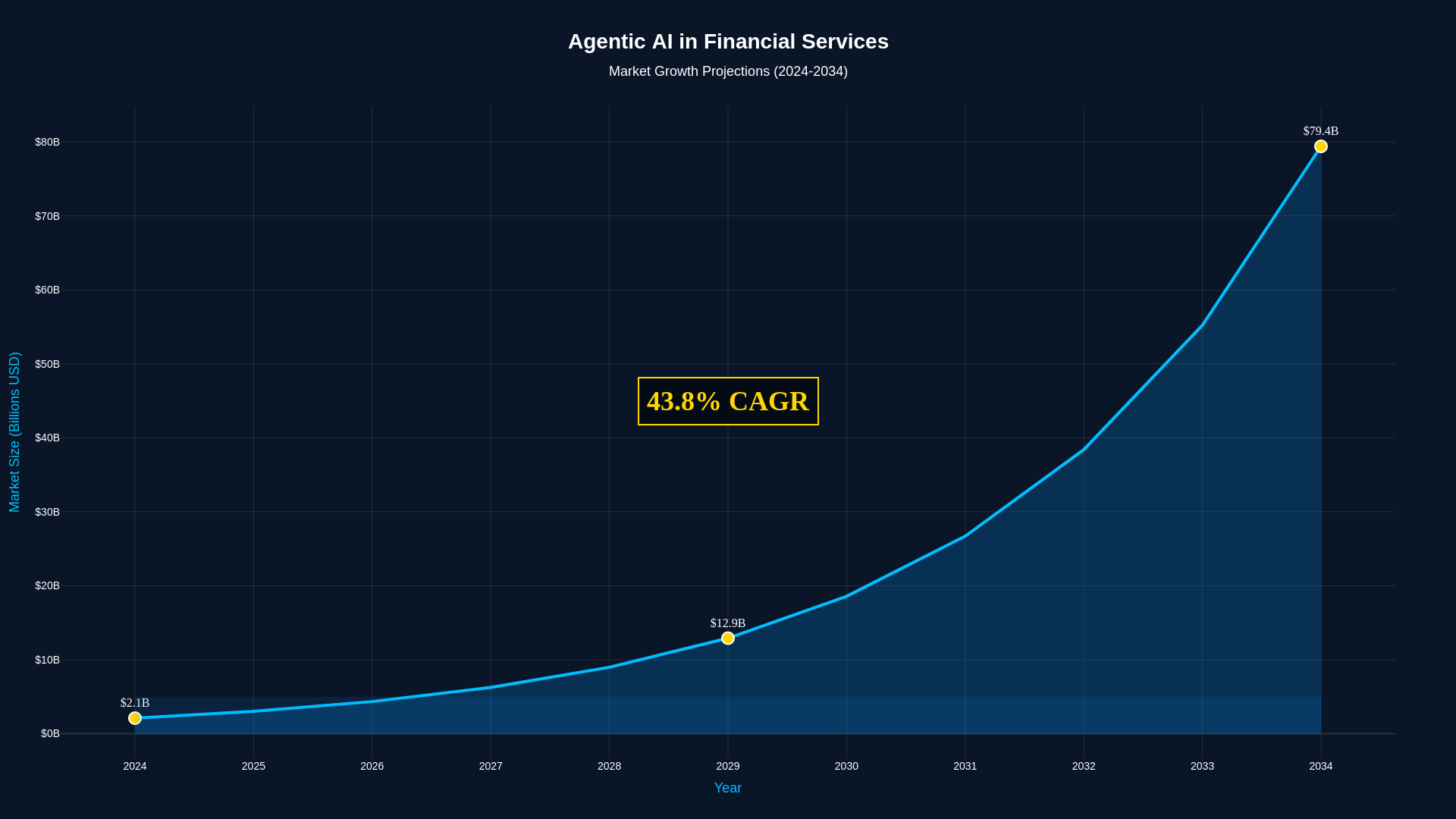
The numbers tell a compelling story: the market for agentic AI in financial services is projected to explode from $2.1 billion in 2024 to over $80 billion by 2034. That’s a compound annual growth rate of 43.8%. But beyond the market projections, what’s truly remarkable is what these systems are already doing—and what they’re about to unlock.

What’s Happening: The Convergence of Two Exponential Technologies
Agentic Finance sits at the intersection of two of the most transformative technologies of our time: artificial intelligence and blockchain. But this isn’t just about putting two buzzwords together. It’s about a fundamental architectural shift in how financial systems operate.
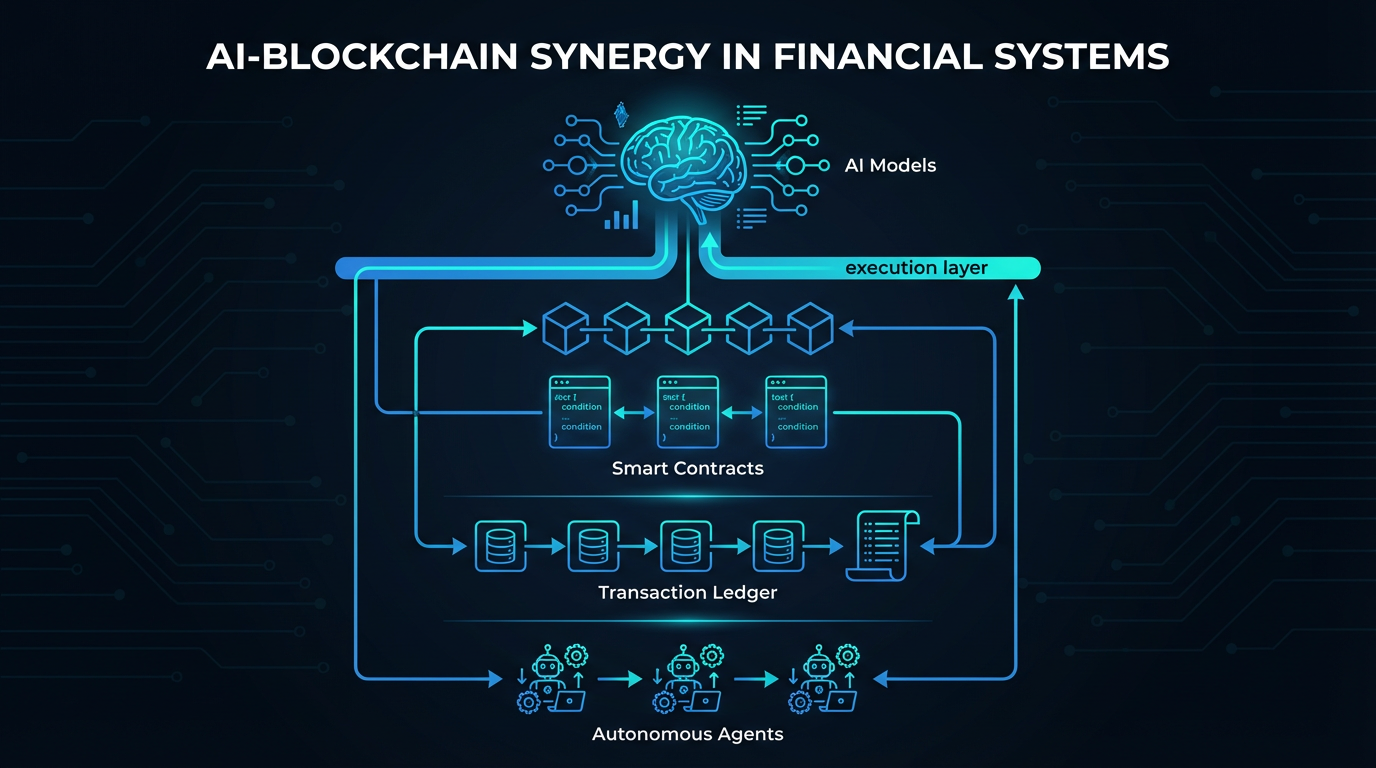
Think of it this way: AI is the brain, blockchain is the nervous system.
AI—particularly large language models and reinforcement learning systems—provides the decision-making layer. These systems can analyze vast datasets, interpret nuanced contexts, identify non-obvious patterns, and make autonomous decisions that would take human analysts days or weeks to process.
Blockchain provides the execution and verification layer. It’s the immutable ledger that records every transaction, enforces smart contracts, and ensures that every action taken by an AI agent is auditable and tamper-proof. This creates what I call “auditable autonomy”—systems that can act independently while maintaining complete transparency.
The practical applications are already emerging across the financial landscape:
- Autonomous Payments: Visa’s Trusted Agent Protocol and PayPal’s Agent Checkout Protocol are creating the infrastructure for AI-driven commerce. Coinbase’s x402 standard is enabling automated micropayments for machine-to-machine transactions.
- AI-Driven Security: Chainalysis Hexagate provides real-time detection of wallet compromises and malicious transactions, while their Alterya platform uses AI-powered risk scoring to target scams and fraud.
- Tokenized Asset Management: AI agents are managing portfolios of tokenized real-world assets—from fractional real estate to commodities—optimizing allocations and creating liquidity in previously illiquid markets. The tokenized real estate market alone is projected to reach $4 trillion by 2034.
Why It Matters: The Efficiency Frontier Is Shifting
At Savanti Investments, we’ve been building in this space for years. Our QuantAI™ platform leverages machine learning to identify market inefficiencies that traditional analysis misses. Our SavantTrade™ system executes strategies with precision that would be impossible for human traders. But even we’re seeing the pace of change accelerate.
The institutions that are moving first are seeing dramatic results:
JPMorgan Chase is deploying a generative AI assistant to over 140,000 employees, targeting more than $1.5 billion in value from productivity gains and risk reduction. They’ve reported a 95% drop in false fraud alerts after shifting to agentic AI.
Wells Fargo’s “Fargo” assistant has handled over 200 million autonomous customer interactions. Klarna achieved an 89% first-contact resolution rate using autonomous agents—a level of efficiency that fundamentally changes the economics of customer service.
Elliptic, working with MIT and IBM, used machine learning on blockchain data to increase fraud detection rates from 0.1% to over 27%. That’s not incremental improvement—that’s a paradigm shift.
But the implications go far beyond operational efficiency. Agentic Finance is democratizing access to sophisticated financial services that were previously reserved for high-net-worth individuals. AI agents can deliver personalized financial planning, portfolio optimization, and real-time risk management to anyone with a smartphone. This is financial inclusion at scale.
The Expert View: Navigating the Regulatory Maze
Of course, with great power comes great regulatory scrutiny—and rightfully so. The autonomy that makes these systems powerful also makes them potentially dangerous if not properly governed.
The regulatory landscape is evolving rapidly, and it’s fragmented. In the United States, we have the CFPB focusing on fair lending, the SEC on investor protection and AI-driven conflicts of interest, and banking regulators (OCC, Fed, FDIC) on model risk management. Each agency is applying its own lens to the same technology.
The European Union has taken the most comprehensive approach with the EU AI Act, which employs a risk-based framework. High-risk use cases common in finance—credit scoring, fraud prevention, AML systems—face stringent obligations including bias testing, human oversight, and conformity assessments.
The core concerns are consistent across jurisdictions:
- Explainability: Regulators demand that institutions be able to explain the reasoning behind AI-driven decisions, particularly in high-stakes areas like credit scoring.
- Bias and Fairness: AI models trained on historical data can perpetuate and amplify existing societal biases. Regular disparate impact testing is becoming mandatory.
- Data Privacy: The vast datasets required to train AI agents make data governance a critical compliance issue.
- Accountability: When an autonomous agent makes a mistake, who’s responsible? Establishing clear lines of accountability is crucial.
At Savanti, we’ve built governance frameworks from day one. Every model we deploy has human-in-the-loop oversight for critical decisions. Every data source is vetted for bias. Every action is logged and auditable. This isn’t just good compliance—it’s good business.
Real-World Implications: The Transformation Is Already Underway
The shift to Agentic Finance isn’t a future scenario—it’s happening now, and it’s reshaping competitive dynamics across the industry.
Consider the back office. Agentic AI is accelerating the financial close process by 30-50% through automated reconciliation and reporting. It’s transforming accounts receivable and payable with intelligent invoice processing and dispute resolution. It’s enabling proactive budget management with real-time spending analysis.
These aren’t marginal improvements. They’re fundamental changes to the cost structure of financial services. Institutions that move quickly will enjoy a significant competitive advantage. Those that don’t risk becoming uncompetitive as the industry’s efficiency frontier shifts.
In trading and investment management, AI agents are monitoring markets 24/7, detecting non-obvious correlations, and optimizing portfolio allocations in real-time. In credit risk, agents are continuously evaluating borrower solvency, moving beyond static assessments to dynamic, real-time risk management.
But perhaps the most profound implication is cultural. The role of financial professionals is evolving from “doer” to “verifier” and “strategist.” The future belongs to those who can design, oversee, and manage fleets of AI agents—who can focus on high-value strategic tasks that require human creativity and ethical judgment.
This requires a new kind of literacy. At Savanti, we’re investing heavily in training our team to be “AI fluent”—to understand not just what these systems can do, but how they work, where they can fail, and how to govern them effectively.
The Risks We Can’t Ignore
I’d be remiss if I didn’t address the risks head-on. The autonomy that makes these systems powerful also makes them potentially dangerous.
Cybersecurity is paramount. Granting AI agents autonomous access to internal systems and sensitive data dramatically expands the attack surface. Malicious actors could exploit these agents through prompt injection or other attacks.
Decision errors are inevitable. AI models can “hallucinate” or misinterpret data. In a high-stakes financial context, a single error by an autonomous agent could result in significant losses or compliance breaches.
Systemic risk is a real concern. The synchronized actions of thousands of AI agents reacting to the same market signal could create “herding behavior,” leading to flash crashes or liquidity crises. This concentration of decision-making logic poses a new form of systemic risk that regulators are only beginning to grapple with.
Algorithmic bias remains a persistent challenge. Without rigorous oversight, autonomous systems can perpetuate and scale historical biases present in training data, leading to systematic discrimination in lending, insurance, and other critical areas.
And then there’s the question of accountability. When an autonomous agent makes a mistake, determining liability is complex. The opaque nature of complex models makes it challenging to trace the source of an error.
These aren’t theoretical concerns. They’re real risks that require real solutions. The institutions that succeed will be those that build robust governance frameworks, invest in security by design, and maintain meaningful human oversight.
Looking Forward: The Path to Autonomous Finance
So where does this go? I see three potential scenarios playing out:
The Cautious Integrator: Many institutions will take a measured approach, starting with internal, employee-facing use cases to demonstrate ROI and build confidence. They’ll focus on automating well-defined, high-volume tasks in the back office before moving to more complex, client-facing applications. This path prioritizes risk management but may cede a first-mover advantage.
The Bold Pioneer: A smaller group of digitally native firms and forward-thinking incumbents will move aggressively to build an “AI-first” operating model. They’ll invest heavily in cloud-native infrastructure, modern data architecture, and strategic partnerships. These pioneers aim to capture a significant competitive advantage, but they also assume greater implementation and regulatory risk.
The Legacy Laggard: Institutions that fail to move beyond pilot projects and address their underlying technical debt risk becoming uncompetitive. Burdened by high operational costs and an inability to innovate, these firms may face declining margins and market share.
At Savanti, we’re firmly in the Bold Pioneer camp. We believe the future belongs to those who embrace this change strategically—balancing bold innovation with disciplined risk management.
The rise of Agentic Finance isn’t just a technological trend. It’s a fundamental re-architecting of the financial industry. The convergence of AI and blockchain is creating systems that are more efficient, more transparent, and more accessible than anything we’ve seen before.
But technology alone isn’t enough. Success requires robust governance, meaningful human oversight, and a commitment to ethical AI development. It requires investing in people—in training, in change management, in building organizations that can thrive in an AI-augmented world.
The future of finance is autonomous. The question isn’t whether this transformation will happen—it’s whether you’ll be leading it or reacting to it.
At Savanti Investments, we’re building that future. Through QuantAI™, SavantTrade™, and our broader platform Convirtio, we’re creating the infrastructure for the next generation of financial services. We’re doing it with our eyes wide open to the risks, with robust governance frameworks, and with a deep commitment to democratizing access to sophisticated financial tools.
The era of Agentic Finance is here. And it’s going to be extraordinary.
Important Disclosures:
This article is provided for educational and informational purposes only and does not constitute investment advice, financial advice, trading advice, or any other sort of advice. The content is not intended to be a substitute for professional financial advice. Savanti Investments and its affiliates do not guarantee any specific outcome or profit. Any forward-looking statements regarding market trends, technological developments, or investment opportunities are based on current expectations and are subject to risks and uncertainties. Past performance is not indicative of future results.
Savanti Investments is a registered investment adviser. Information presented is for educational purposes only and does not intend to make an offer or solicitation for the sale or purchase of any specific securities, investments, or investment strategies. Investments involve risk and, unless otherwise stated, are not guaranteed. Be sure to first consult with a qualified financial adviser and/or tax professional before implementing any strategy discussed herein. This article is not a solicitation of an offer to buy or sell, or a recommendation of any security or investment product. This communication is intended for persons who reside in jurisdictions where Savanti Investments is authorized to conduct business.
QuantAI™, SavantTrade™, and Convirtio are trademarks of Savanti Investments. All rights reserved.