Picture this: Your marketing director walks into your office with a puzzled look. “We’re ranking #1 for all our target keywords,” she says, “but our website traffic just dropped 40%.”
Welcome to 2026, where perfect SEO means nothing if you’re not AI-ready.
The rules have changed. ChatGPT Search, Perplexity, Google’s AI Overviews (Google Generative Search), and Microsoft Copilot aren’t just answering questions—they’re answering them without sending users to your website. We’re living in what I call the “zero-visit world,” where 60-70% of searches now end without a single click. Your content might be fueling AI responses, but if you’re not optimizing for this new reality, you’re essentially writing free content for machines while your competitors capture the value.
Traditional SEO isn’t dead—it’s evolved. And if you’re still playing by the old rules, you’re already behind.
The New Search Landscape: From Links to Answers
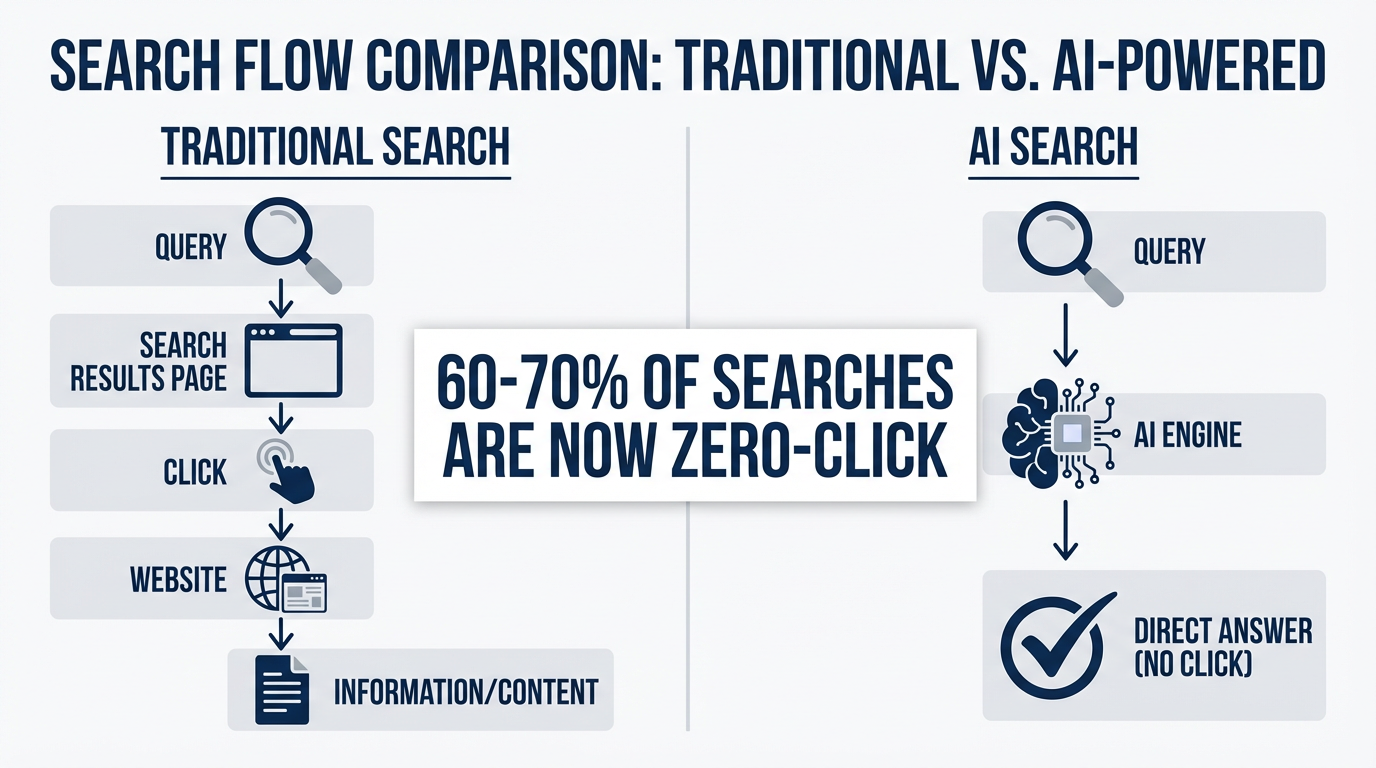
The paradigm shift is complete. Search engines have become answer engines, and the implications are staggering.
In 2026, AI-powered search platforms have fundamentally altered how people discover information. Google’s AI Overviews now appear in over 98% of queries, synthesizing information from multiple sources and presenting it directly on the results page. ChatGPT saw a 44% traffic boost in late 2024, and today, 80% of B2B technology buyers use Large Language Models for vendor research. Perplexity has become the go-to for research-style queries, while Microsoft Copilot has embedded itself into the daily workflow of millions through Windows and Microsoft 365 integration.
The data is unambiguous: by 2026, zero-click searches account for 68-72% of all Google queries globally, with mobile devices hitting 75%. For informational queries—the bread and butter of content marketing—the zero-click rate soars to 80%. Even local searches, once a reliable traffic driver, now see 62% of users getting what they need without ever visiting a website.
Here’s what’s actually happening: AI answer engines use Retrieval-Augmented Generation (RAG) to pull real-time information from the web, parse it into digestible chunks, and synthesize coherent responses. They’re not just indexing your content—they’re understanding it, evaluating its authority, and deciding whether it’s citation-worthy. And here’s the kicker: they have clear preferences. ChatGPT cites Wikipedia 47.9% of the time and Reddit 11.3%. Google’s AI Overviews favor Reddit (21%), YouTube (18.8%), and Quora (14.3%). Perplexity leans even harder on Reddit at 46.7%.
If your content strategy doesn’t account for these platforms and formats, you’re invisible to the systems that now control information discovery.
Why This Matters: The Death of Traffic (But Not SEO)
Let’s address the elephant in the room: Is traditional SEO dead?
No. But it’s not what it used to be.
The business impact of zero-click search is severe. B2B companies are reporting 70-80% traffic declines in some sectors. A 2025 study found that 73% of B2B websites lost traffic year-over-year, with an average decline of 34%. This isn’t because demand disappeared—it’s been redistributed. User attention now lives on the SERP itself, in AI chat interfaces, and on platforms like Reddit and LinkedIn that AI systems trust and cite frequently.
The metrics that mattered for the past two decades—page views, session duration, bounce rate—are becoming less relevant. The new KPIs are:
- Citation frequency: How often are you referenced in AI-generated answers?
- AI visibility score: What’s your share of voice across key queries?
- Authority metrics: Are you being positioned as a primary source?
- Assisted conversions: Can you track the customer journey that begins with a zero-click interaction?
But here’s the contrarian view that matters: Traditional SEO fundamentals are more important than ever. Google’s Search Liaison, Danny Sullivan, has been emphatic about this. The “new stuff” in AI search is built directly on the “old stuff” of SEO. AI models are trained to look for the same signals that have always mattered: expertise, experience, authoritativeness, and trustworthiness (E-E-A-T).
The difference is that now you’re optimizing for two audiences: human readers and AI systems that act as information intermediaries. Get the fundamentals right—clear structure, authoritative content, proper technical implementation—and you’re simultaneously optimizing for both.
The Tactical Playbook: Five Strategies for AI Dominance
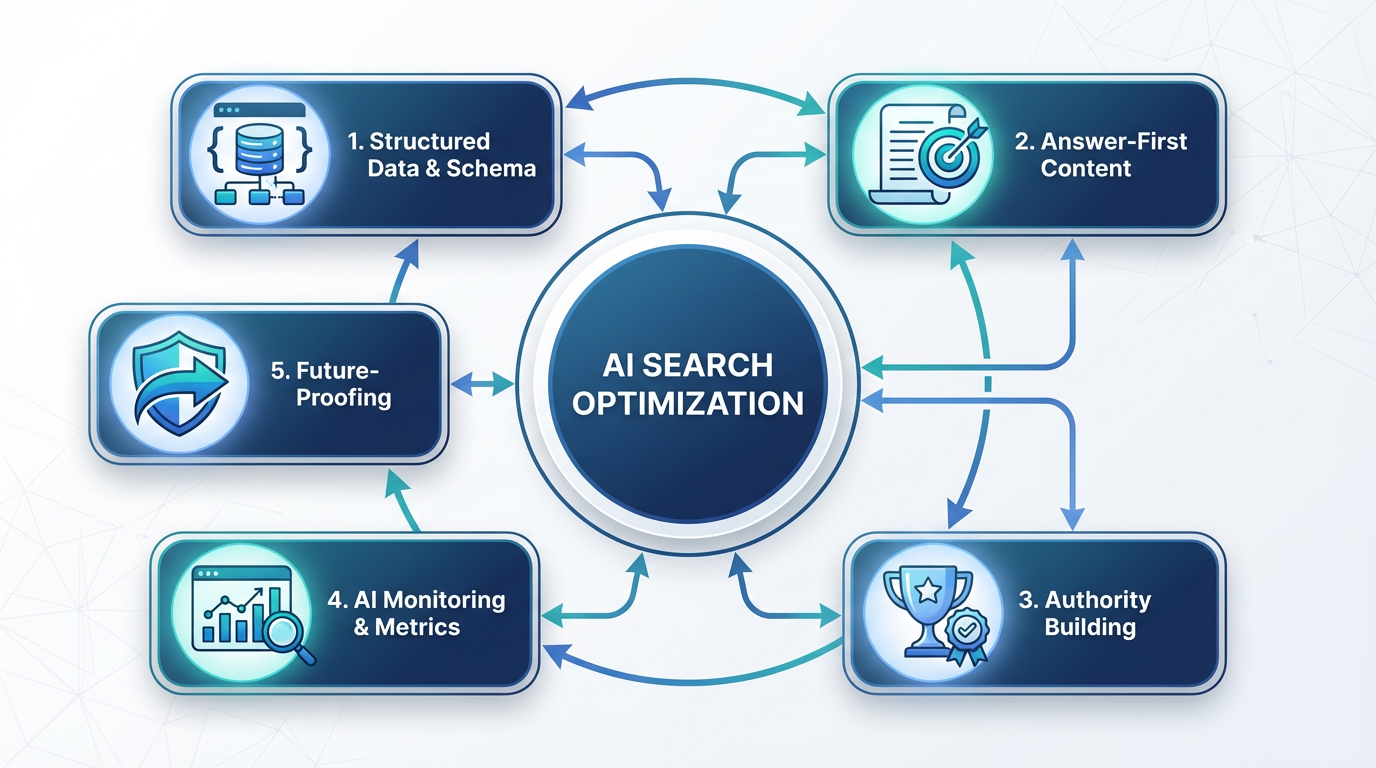
After building companies across AI, finance, and marketing tech—from SavantTrade to Convirtio—I’ve learned that paradigm shifts reward those who adapt quickly. Here’s your tactical playbook for 2026.
Strategy 1: Master Structured Data and Schema Markup
Schema markup is no longer optional—it’s the language AI systems use to understand your content. Implement JSON-LD structured data for every content type: articles, FAQs, how-tos, products, events, and local business information.
Action steps:
- Prioritize `FAQPage`, `HowTo`, and `Article` schema types
- Use entity markup to help AI systems understand relationships between concepts
- Implement breadcrumb and sitelinks schema for better content hierarchy
- Test your implementation with Google’s Rich Results Test and Schema.org validator
The goal is to make your content machine-readable. AI systems don’t interpret context the way humans do—they need explicit signals about what your content is, what it covers, and why it’s authoritative.
Strategy 2: Create “Answer-First” Content
AI models favor content that provides direct, concise answers. The “answer-first” structure is your template:
- Lead with a 30-60 word direct answer to the core question
- Follow with 2-3 short paragraphs providing essential context
- Include a scannable bulleted list summarizing key points
- Add a brief, illustrative example when relevant
Structure your articles with question-based headings (H2, H3) that mirror natural language queries. “How do I optimize for AI search?” is better than “AI Search Optimization Techniques.” Write in a conversational tone that aligns with voice queries and multimodal search.
Break content into modular, “snippable” pieces. Listicles, comparison tables, and step-by-step guides are highly cited by LLMs because they’re easy to parse and extract. Avoid long, dense paragraphs—they’re harder for AI systems to chunk and repurpose.
Strategy 3: Build Authority in the Citation Economy
In the zero-visit world, being cited is the new currency. Here’s how to become a primary source:
Establish topical authority:
- Create comprehensive, definitive content on your core topics
- Publish consistently to demonstrate ongoing expertise
- Use data, original research, and expert quotes to differentiate
- Build content clusters that interlink and reinforce your authority
Leverage high-trust platforms:
- Maintain an active presence on Reddit, Quora, and industry forums
- Contribute to Wikipedia where appropriate (following their guidelines)
- Publish on Medium, LinkedIn, and other platforms AI systems frequently cite
- Engage in podcast interviews and video content (YouTube is heavily cited)
Build a backlink profile that signals authority:
- Earn links from .edu and .gov domains
- Get cited by industry publications and thought leaders
- Participate in industry research and reports
- Create linkable assets: original data, tools, calculators, comprehensive guides
At Savanti and QuantAI, we’ve seen firsthand how AI-powered analytics platforms are adapting to track these new metrics. The companies winning in 2026 are those that shifted from traffic-focused KPIs to authority-focused ones.
Strategy 4: Implement AI-Specific Monitoring and Measurement
You can’t optimize what you don’t measure. The challenge is that traditional analytics platforms weren’t built for a zero-click world.
New metrics to track:
- AI citation frequency: Use tools like BrightEdge’s DataMind or custom monitoring to track how often your brand appears in AI responses
- Share of voice in AI answers: What percentage of AI responses in your category mention your brand?
- Featured snippet and AI Overview presence: Track your visibility in Google’s AI-generated content
- Platform-specific performance: Monitor your citation rates across ChatGPT, Perplexity, and Google separately—they have different preferences
Set up attribution models that account for assisted conversions:
- Implement brand search tracking to capture users who discover you via AI, then search directly
- Use UTM parameters and campaign tracking for content that might be cited
- Monitor direct traffic spikes that correlate with AI visibility increases
- Survey customers about their discovery journey
The ROI of AI optimization is real, but it requires new measurement frameworks. Companies that have adapted report higher conversion rates from AI-driven traffic—users who arrive after an AI interaction are often further along in their decision-making process.
Strategy 5: Future-Proof Your Presence
The AI search landscape will continue to evolve rapidly. Future-proofing requires diversification and adaptability.
Multimodal optimization:
- Optimize for voice search with conversational, question-based content
- Include high-quality images with descriptive alt text and captions
- Create video content (YouTube is a top-cited source)
- Ensure your content works across devices and formats
Platform diversification:
- Don’t rely solely on Google—optimize for ChatGPT, Perplexity, and emerging platforms
- Build owned audiences through email, communities, and direct channels
- Invest in brand building that transcends any single platform
- Create content that works independently of search algorithms
Adaptive content strategies:
- Monitor AI platform updates and adjust quickly
- Test different content formats and structures
- A/B test AI-optimized vs. traditional content approaches
- Stay informed about regulatory changes that might affect AI search
Lessons from the Search Optimization Expert Trenches
Building companies across multiple domains—from hedge fund technology with SavantTrade to marketing automation with Convirtio—has taught me that the winners in any paradigm shift are those who see it coming and adapt before it’s obvious.
In 2024, when AI Overviews started appearing in 42% of searches, most companies were still optimizing for click-through rates. By 2025, when AI was providing the top result in 98% of queries, the early adapters had already rebuilt their content strategies. Today, in 2026, the gap between AI-ready companies and those still playing by 2020 rules is a chasm.
The opportunity window is still open, but it’s closing. First-movers in AI optimization are seeing:
- Higher brand authority and recognition
- Better conversion rates from more qualified traffic
- Reduced dependency on algorithm changes
- Competitive moats that are hard to replicate
The cost of waiting is compounding. Every day you’re not optimizing for AI search is a day your competitors are building citation authority, establishing themselves as primary sources, and capturing the attention of the systems that now control information discovery.
What’s Next: The 2026-2027 Outlook
Looking ahead, several trends will shape the next phase of AI search:
Consolidation and competition: Expect continued innovation from Google, OpenAI, Microsoft, and Perplexity, with potential new entrants. The platform that best balances user experience, publisher interests, and monetization will likely dominate.
Regulatory developments: Copyright and attribution battles are heating up. Publishers are demanding fair compensation for content used in AI training and responses. Expect new regulations around transparency, attribution requirements, and potentially revenue-sharing models.
Monetization evolution: The current model—where AI systems provide free answers using publisher content—is unsustainable. Watch for new monetization frameworks, potentially including:
- Paid citation programs
- Revenue sharing for frequently cited sources
- Premium content tiers that AI systems must pay to access
- Direct partnerships between publishers and AI platforms
Hybrid search experiences: The future likely isn’t purely zero-click or purely traditional. Expect hybrid models where AI provides summaries with clear pathways to deeper engagement with source content.
Your Move, AI Search
The zero-visit world is here. The question isn’t whether to adapt—it’s how quickly you can execute.
Start with these immediate actions:
- Audit your current content for AI-readiness: Is it structured? Does it provide direct answers? Is it citation-worthy?
- Implement comprehensive schema markup across your site
- Create an FAQ section for your most important topics using question-based headings
- Establish presence on high-trust platforms like Reddit and industry forums
- Set up AI visibility tracking to measure your citation frequency and share of voice
The companies that will dominate in 2027 and beyond are those that recognize this isn’t just an SEO evolution—it’s a fundamental shift in how information is discovered, evaluated, and consumed. Traditional SEO gave you traffic. AI optimization gives you authority. And in a world where AI systems are the gatekeepers of information, authority is everything.
The playbook is clear. The opportunity is real. The only question is: Are you ready to execute?
—
Frequently Asked Questions
What is AI-ready SEO? or Answer Engine Optimization (AEO)
AI-ready SEO, also called Answer Engine Optimization (AEO), is the practice of optimizing content to be easily discovered, understood, and cited by AI-powered search systems like ChatGPT, Perplexity, and Google’s AI Overviews. It focuses on structured data, direct answers, and building authority rather than just ranking for keywords.
How do AI answer engines choose their sources?
AI answer engines use Retrieval-Augmented Generation (RAG) to pull real-time information from the web. They evaluate sources based on authority signals (backlinks, domain trust), content structure (schema markup, clear formatting), and platform reputation. They show strong preferences for user-generated content platforms like Reddit, Wikipedia, and YouTube.
Is traditional SEO dead in 2026?
No. Traditional SEO fundamentals—quality content, proper structure, technical optimization, and E-E-A-T signals—are more important than ever. AI systems are trained to look for the same authority signals that traditional SEO prioritized. The difference is you’re now optimizing for both human readers and AI systems simultaneously.
What is a zero-click search?
A zero-click search is a query that’s answered directly on the search results page without the user clicking through to any website. In 2026, 60-70% of all searches are zero-click, with AI-generated summaries and featured snippets providing answers without requiring website visits.
How can I optimize my content for AI search engine results?
Implement comprehensive schema markup, create answer-first content with clear structure, use question-based headings, write in a conversational tone, break content into snippable chunks, build topical authority, and establish presence on platforms AI systems frequently cite like Reddit and YouTube.
What metrics should I track for AI search visibility?
Track citation frequency (how often you’re mentioned in AI responses), AI share of voice (your percentage of mentions in your category), featured snippet and AI Overview presence, platform-specific performance across different AI systems, and assisted conversions from users who discover you via AI.
How long does it take to see results from AI search optimization?
Initial improvements in citation frequency can appear within 4-8 weeks of implementing structured data and answer-first content. Building significant authority and share of voice typically takes 3-6 months of consistent optimization. The timeline depends on your existing domain authority, content quality, and competitive landscape.