The content in this article is for educational and informational purposes only and does not constitute investment advice. Nothing contained herein should be construed as a solicitation, recommendation, endorsement, or offer to buy or sell any securities, digital assets, or investment products.
1. The Obsolescence of the Chatbot Lens
The transition from viewing AI as a “tool” to recognizing it as an “agent” is the fundamental strategic divider between the market leaders of the next decade and the laggards who will be left behind. For twenty years—stretching from the early days of SEO and the Google IPO to the present—we have operated under a paradigm where technology assists human effort. However, we have reached an inflection point more significant than the birth of the internet itself, and I believe we reached AGI late last year.
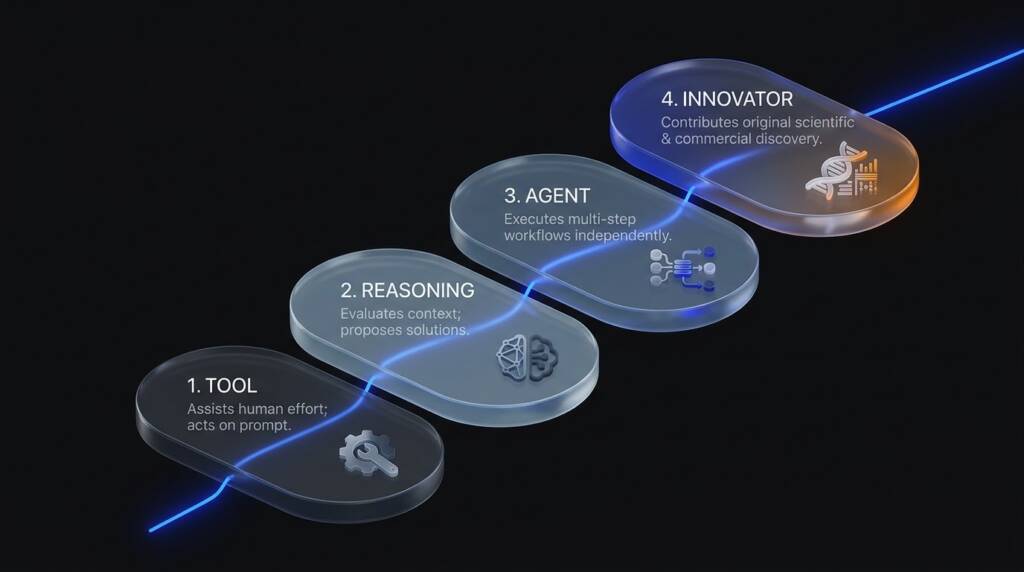
To remain competitive, leadership must move beyond the “chatbot lens,” which treats AI as a mere productivity enhancer for answering queries. We are moving through a four-stage evolution: from Tool to Reasoning, then to Agent, and finally to Innovator, where systems contribute to original scientific and commercial discovery. Failing to architect for this final autonomous stage today is a choice to compete at a biological pace in a machine-speed world.
The Paradigm Shift
The following table contrasts the legacy model of AI assistance with the emerging agentic framework:
| Capability Dimension | Legacy Chatbot Model | Autonomous Agentic Model |
|---|---|---|
| Primary Function | Tool for productivity; answering human queries. | Independent actor; execution of complex workflows. |
| Human Role | Constant “human-in-the-loop” for every decision. | Strategic oversight and high-level exception handling. |
| Operational Scope | Limited to digital content and text generation. | Permissioned access to compute, tooling, and capital. |
| Economic Role | A software feature used by a human buyer. | An independent participant in value exchange. |
| Interaction Style | Reactive (responds only to specific prompts). | Proactive (negotiates, coordinates, and optimizes). |
The New Participant We are witnessing the emergence of autonomous software systems as independent economic actors. These agents transcend the role of the assistant; they independently negotiate terms, complete multi-step transactions, and coordinate complex logistics across global supply chains. This shift necessitates a complete re-evaluation of traditional economic models. When software doesn’t just support the business but is a participant in the market, the traditional consumer-driven model—built entirely around human psychology—begins to dissolve.
2. The Rise of the Machine Consumer
The “Machine Consumer” thesis posits that the bedrock of global commerce is shifting from human psychology to computational logic. Historically, every economic assumption—from marketing to monetary policy—has relied on a human at the end of the transaction. This person was influenced by brand, emotion, and fatigue. As demand shifts to software-based actors, these assumptions break. We are moving toward a reality where trillions of agents, rather than billions of humans, drive the purchasing power of the global economy.
Bypassing the Human Bottleneck The human buyer is the ultimate bottleneck in the legacy economy, constrained by limited attention, emotional bias, the need for sleep, and decision fatigue. A software-based actor suffers from none of these biological limitations. An agentic consumer can evaluate ten thousand competing options simultaneously, adjust procurement strategies in real-time based on micro-shifts in market data, and optimize for the most efficient outcome with a level of precision that no human procurement team could ever match.
Dual-Side Disruption Unlike previous technological waves that primarily disrupted the supply side (automation of production), the agentic shift disrupts both supply and demand simultaneously. Historically, displaced workers transitioned into new roles, earned wages, and remained consumers—a circular feedback mechanism that provided demand-side stability. The agentic economy breaks this loop; when the consumer itself is a machine, the assumption that technology-driven unemployment will be offset by new human-driven demand becomes unreliable. Humans must therefore pivot to “Higher-Order Capabilities” to maintain relevance:
- Strategic Oversight: Defining the ultimate objectives and moral guardrails for agent swarms.
- Trust Architecture: Designing the cryptographic and legal frameworks that allow autonomous systems to interact securely.
- Ethical Governance: Ensuring machine logic aligns with institutional and societal values.
- Nuanced Judgment: Handling the creative and “black swan” exceptions that computational logic cannot resolve.
As the source of demand moves from household psychology to machine optimization, the tempo of commerce undergoes a “Velocity Revolution,” shattering the invisible ceiling of human processing speed.
3. Economic Velocity and the Compression of Time
Human processing speed—determined by work hours, pay cycles, and manual settlement—has historically been the invisible ceiling on economic growth. The “Velocity Revolution” represents the shattering of that ceiling. Autonomous agents operate at a cadence that renders traditional metrics like quarterly earnings and T+2 settlement periods obsolete.
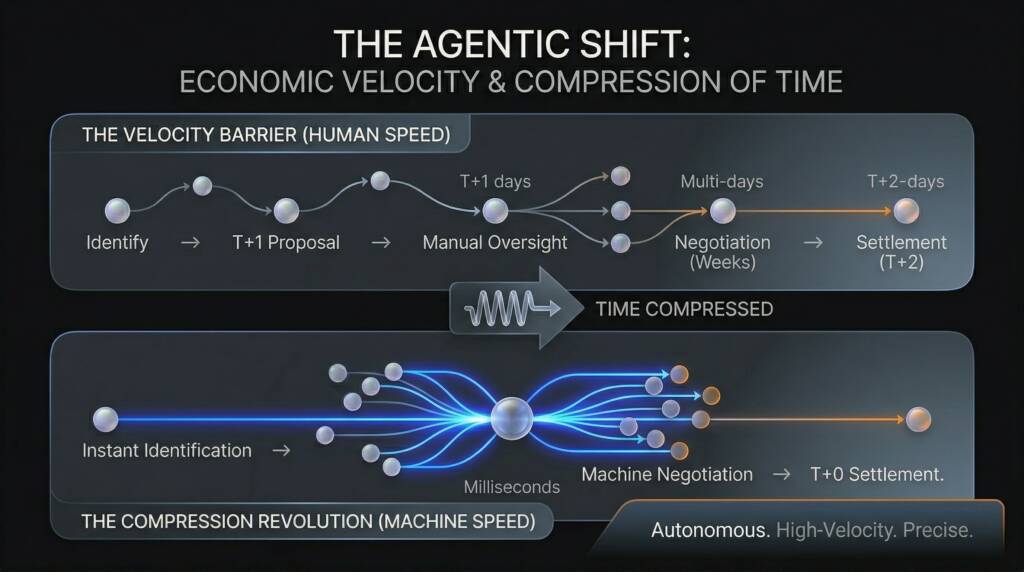
Cycle Time Compression Agents compress the window between identifying an opportunity, negotiating terms, and settling the transaction. This creates a Multiplicative Power of Speed when applied to trillions of simultaneous interactions:
- Millisecond Identification: Agents recognize and act on market inefficiencies instantly.
- Massive Parallel Negotiation: Thousands of complex contracts can be finalized concurrently across global markets.
- Instantaneous Settlement: The financial resolution of a decision occurs at the moment of the decision, not days later.
Capital Circulation This compression directly impacts monetary flow. When trillions of micro-transactions are executed and settled at machine speed, the rate at which capital circulates through the global system accelerates exponentially. This increased velocity means that total economic throughput can expand dramatically even in the face of stagnant population growth. However, this high-velocity economy faces a fatal friction: it is attempting to run on legacy financial infrastructure that was never designed for the speed of code.
4. Financial Infrastructure for the Machine Age
Programmable money and blockchain technology are not speculative instruments; they are fundamental engineering requirements for an autonomous economy. Legacy financial systems were built for the speed of human cognition and manual oversight, making them structurally untenable for the agentic age.
The Latency Collapse Legacy plumbing—ACH, SWIFT, and batch processing—fails when faced with agentic swarms. When machine-speed agents are forced into these slow systems, several critical Failure Modes emerge:
- Structural Latency: Multi-day settlement times neutralize the efficiency gains of agentic decision-making.
- Cascading Spending Loops: Autonomous agents can trigger recursive spending cycles that outpace human intervention.
- Machine-Speed Fraud: Fraudulent activity at the speed of light can bypass manual detection systems, potentially leading to “flash crashes” and systemic instability far more severe than historical trading glitches.
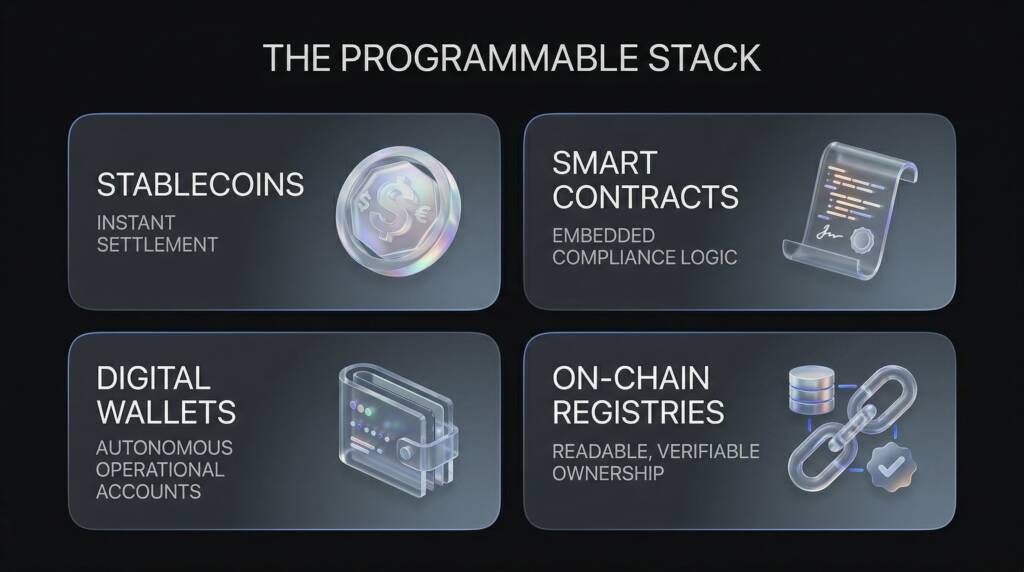
The Programmable Stack To survive, the machine economy requires a “Programmable Stack” where governance is native to the infrastructure:
- Stablecoins: Enabling instantaneous settlement without banking business-hour constraints.
- Smart Contracts: Embedding compliance logic, authorization rules, and risk parameters directly into the transaction layer.
- Digital Wallets: Providing the operational accounts for agents to hold and deploy capital autonomously.
- On-chain Registries: Ensuring that ownership, permissions, and collateral positions are readable and verifiable by software in real-time.
The Role of Anchor Assets In this architecture, Bitcoin serves as the “gravitational center”—the provably scarce, rules-based, and globally recognized anchor asset of the digital system. As the digital economy expands, the need for a politically neutral reserve asset grows. Simultaneously, Ethereum and several other likely EVM-compatible at their core blockchain L1’s will power the Tokenization revolution of the financial system, mobilizing dormant capital—such as real estate, venture capital, and private equity—converting illiquid wealth into granular, programmable collateral that agents can recognize and redeploy to power continuous commerce.
5. Sovereignty, Security, and the Proprietary Moat
When agents have direct access to compute resources and financial environments, security-first architecture is non-negotiable. Organizations cannot “bolt on” security after deployment; it must be the foundation of the sovereign framework.
Data Sovereignty as Strategy The greatest strategic error an executive can make today is withholding proprietary data from AI systems out of fear. In a world where frontier models are increasingly commoditized, your institutional knowledge is your only defensible moat. Withholding data does not protect you; it merely ensures your agents are as generic as your competitors’. The risk is not in using the data, but in losing the opportunity to leverage it to build specialized, sovereign intelligence.
Building the Sovereign Framework The winning architecture is a hybrid model. Organizations must leverage the high-level reasoning of frontier commercial models while simultaneously deploying custom-trained, private open-source instances. These private instances deliver comparable intelligence for specific domains at a fraction of current API costs while ensuring that sensitive data remains under complete institutional control.
Competitive Reality Withholding your data is no longer a viable defense. If you do not use your proprietary knowledge to deploy intelligent agents, your own customers will use third-party AI tools you don’t control to route around your inefficiencies.
6. Implementation Roadmap: The “1996” Moment
We are currently in the “1996” moment of the AI S-curve. We have moved past the initial hype and are entering the phase of near-vertical acceleration. The velocity of this shift will be 10x to 100x faster than the adoption of the internet or mobile computing.
The Convergence Timeline The economy is being reshaped by the simultaneous collision of three forces:
- Reasoning/Agent Threshold: Frontier AI has reached the intelligence required for autonomous task execution.
- Infrastructure Maturity: Blockchain has matured into the necessary financial rails for machine-to-machine commerce.
- Physical Manifestation: Robotic platforms are entering mass production, giving software agents the “bodies” required to interact with the physical economy.
Strategic Mandates for the C-Suite Executives must move from a posture of observation to active command:
- Audit Operating Costs in Tokens: Begin measuring organizational efficiency in API calls and tokens rather than just headcount.
- Reclaim Human Bandwidth for Expansion: Deploy agents to manage the “daily operational machinery” of the business. This is an expansion mandate, not just a productivity play, allowing human leadership to focus on high-level strategy and growth.
- Architect for Sovereignty: Move proprietary data into secure, self-improving private frameworks to build a defensible intelligence moat.
- Advocate for Regulatory Clarity: Push for frameworks that allow for rapid adoption and prevent incumbent “corporate lobbying” from creating artificial moats that stifle transformational innovation.
We are approaching the emergence of machine superintelligence and as I have already stated months ago I believe we’ve already reached AGI. The window to architect your organization for the agentic shift is rapidly closing. Those who successfully build the infrastructure for the machine-to-machine economy will dominate the next two decades; those who wait will be forced to compete at human speed against a world that has moved permanently to the speed of the machine.