This article is for educational and informational purposes only and is not investment advice. The views expressed are those of the author and do not constitute recommendations to buy, sell, or hold any securities or digital assets.
The Quiet Revolution in Your Wallet
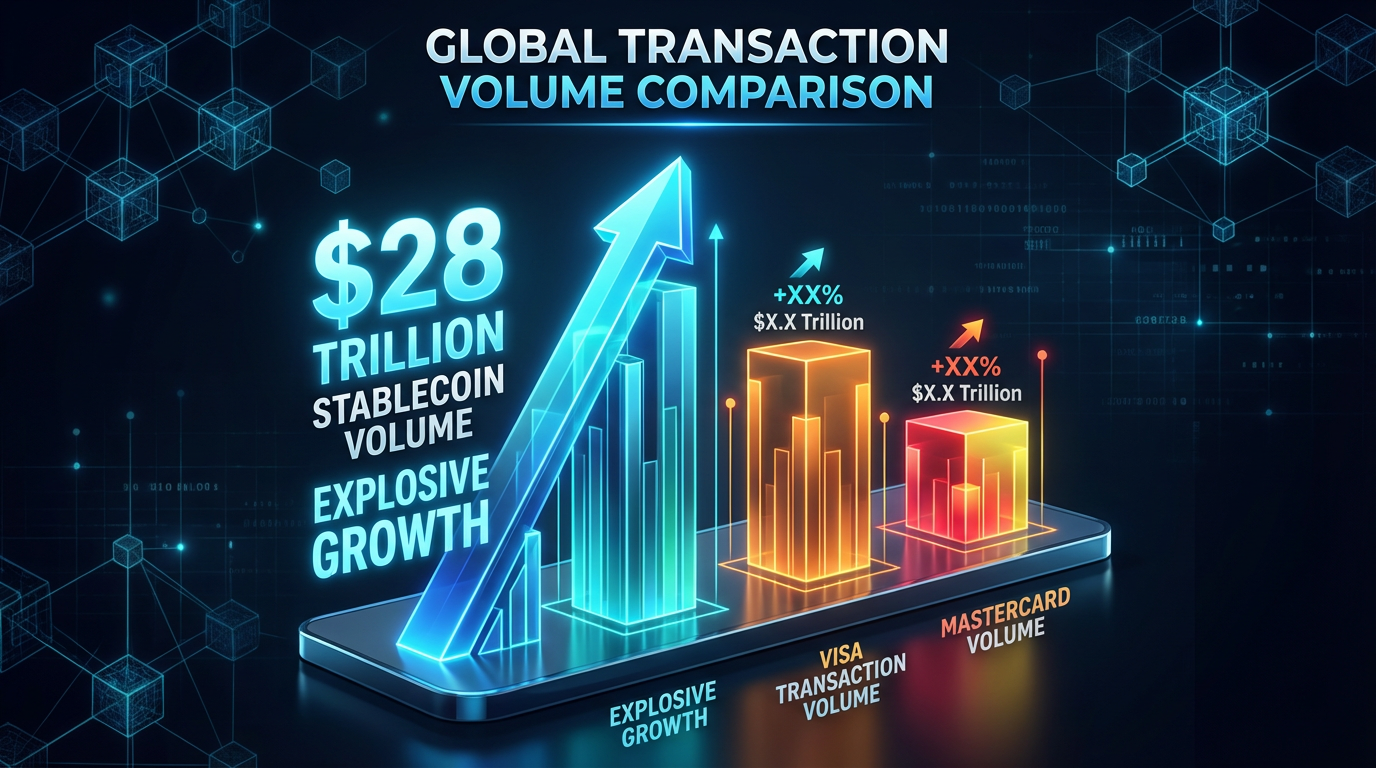
While the world debates the future of artificial intelligence and the next crypto bull run, a more fundamental transformation is happening right under our noses. In 2024, stablecoins—those seemingly boring, dollar-pegged digital tokens—processed an estimated $28 trillion in transaction volume. To put that in perspective, that’s more than Visa and Mastercard combined.
Let that sink in for a moment. A technology that barely existed a decade ago is now moving more value than the world’s two largest payment networks. And yet, most people outside the crypto ecosystem have never used one.
This isn’t just another crypto hype cycle. This is the infrastructure layer of the next financial system being built in real-time. And if you’re in finance, payments, or any business that moves money across borders, you need to understand what’s happening—because the rails are shifting beneath your feet.

What’s Actually Happening: The Numbers Don’t Lie
The scale of stablecoin adoption is staggering. In 2025, global stablecoin payments hit $33 trillion—double Visa’s entire annual processing volume. The total market capitalization of stablecoins has surged to $312 billion as of early 2026, a 50% year-over-year increase. USD Coin (USDC) alone has grown its market cap 72% to $75.3 billion, and it’s now surpassing Tether (USDT) in transfer volume as the preferred choice for corporate treasury and regulated payments.
But here’s where it gets interesting: this isn’t just crypto traders shuffling tokens between exchanges. Major financial institutions are integrating stablecoins into their core operations. Visa has expanded its stablecoin settlement program to support USDC across multiple blockchains, including Stellar, settling over $225 million in pilot programs. Mastercard launched its Crypto Partner Program, working with firms like Tempo and Polygon to connect on-chain infrastructure with its global commerce network. PayPal’s PYUSD stablecoin is now accessible to 435 million users, bridging the gap between traditional finance and digital assets.
And then there’s the regulatory breakthrough. In July 2025, the United States passed the GENIUS Act—the Guiding and Establishing National Innovation for U.S. Stablecoins Act—creating the first comprehensive federal framework for payment stablecoins. This wasn’t a half-measure. The law mandates full 1:1 backing with high-quality liquid assets, restricts issuance to federally regulated entities, and grants stablecoin holders priority claims on reserves in the event of an issuer’s insolvency.
This is the regulatory clarity the industry has been waiting for. And it’s not just the U.S. The European Union’s MiCA framework became fully applicable in early 2025. Hong Kong implemented its Stablecoin Ordinance. The UK is bringing fiat-backed stablecoins into its regulatory perimeter. Singapore, Japan, and the UAE have all implemented licensing regimes. We’re witnessing a global convergence on stablecoin regulation—and that’s the green light for institutional capital.
Why This Matters: The Technology Advantage
So why are stablecoins winning? It’s not magic—it’s math, infrastructure, and incentives.
Traditional payment systems are built on batch processing, correspondent banking intermediaries, and business hours. A wire transfer can take days. A cross-border payment can cost 6% or more in fees. And if you need to move money on a Saturday night? Good luck.
Stablecoins operate 24/7/365. Transactions settle with finality in seconds or minutes. Costs are measured in basis points, not percentage points. And because they’re built on public blockchains, every transaction is transparent, immutable, and auditable. This isn’t just incrementally better—it’s a different paradigm.
For corporations, this unlocks real-time liquidity management. You can move capital across geographies and accounts instantly, freeing up funds that would otherwise be trapped in transit. For remittances, it’s transformative. The World Bank estimates that remittance fees average over 6% globally. Stablecoins can reduce that to a fraction of a percent, putting billions of dollars back into the pockets of people who need it most.
And then there’s programmability. Stablecoins aren’t just digital dollars—they’re programmable digital dollars. You can embed conditional logic into payments via smart contracts. Automated cash sweeps. Escrow services that release funds upon verified events. Machine-to-machine micropayments for autonomous AI agents. In fact, USDC has already accounted for 98.6% of 140 million AI agent transactions in a recent nine-month period. This is the infrastructure layer for the agentic economy we’re building at Savanti Investments.
The Institutional Inflection Point
Here’s what I find most compelling: we’re past the pilot phase. This is production-scale adoption.
SoFi, a U.S. nationally chartered bank, launched SoFiUSD—the first stablecoin issued by a regulated bank under the GENIUS Act framework, with custody infrastructure provided by BitGo. BlackRock has integrated USDC into its tokenized fund infrastructure. JPMorgan analysts have noted USDC’s appeal to institutional investors. Ripple launched RLUSD, an enterprise-grade, dollar-backed stablecoin designed as a complete, ready-to-deploy solution for financial institutions. Sonic Labs unveiled USSD, a network-native stablecoin backed by U.S. Treasury bills from asset managers like BlackRock and WisdomTree.
This isn’t fringe anymore. This is the financial establishment recognizing that blockchain-based settlement is superior infrastructure.
And it’s not just payments. Stablecoins are becoming the settlement layer for the tokenization of real-world assets (RWAs)—a market that’s projected to reach trillions of dollars. When you tokenize a Treasury bond, a piece of real estate, or a private equity stake, you need a stable, liquid, on-chain currency to settle those trades. That’s where stablecoins come in. They’re the connective tissue between traditional finance and the on-chain economy.

The Risks We Can’t Ignore
Now, let’s be clear-eyed about the risks. This isn’t a panacea, and there are legitimate concerns that need to be addressed.
First, there’s the risk of a run on a stablecoin. If confidence in an issuer’s ability to honor redemptions collapses, you could see a mass sell-off that forces a fire sale of reserve assets, potentially disrupting short-term credit markets. The GENIUS Act mitigates this by mandating 1:1 backing with high-quality liquid assets and granting holders priority claims, but operational integrity is paramount. Transparency and regular audits are non-negotiable.
Second, there’s the macroeconomic risk of currency substitution. In emerging markets with high inflation or economic instability, the ease of access to digital dollars could lead citizens to abandon their national currency. This undermines the ability of central banks to conduct effective monetary policy. The IMF has flagged this as a significant risk that requires careful management through robust domestic policy and international cooperation.
Third, there’s the challenge of illicit finance. The cross-border and pseudonymous nature of stablecoin transactions can be exploited for money laundering and terrorist financing. While transactions are recorded on a public ledger, linking addresses to real-world identities requires diligent AML/KYC enforcement by exchanges and on/off-ramps. This is an area where regulation and technology need to work hand-in-hand.
And finally, there’s the issue of consumer protection. Unlike traditional payment card transactions, blockchain-based transfers are generally irreversible. There’s no chargeback mechanism. If you’re scammed or make a mistake, recovering your funds is extremely difficult. This is a UX and regulatory challenge that the industry needs to solve if stablecoins are going to achieve mainstream consumer adoption.
The Future: Convergence, Not Disruption
So where does this go from here?
I don’t think we’re heading toward a world where stablecoins “replace” Visa and Mastercard. I think we’re heading toward a world where they converge. Visa and Mastercard are already integrating stablecoins into their settlement infrastructure. They’re treating this as a technological upgrade, not a competitive threat. And that’s the right move.
The future will likely be characterized by a multi-polar market where different types of stablecoins coexist to serve distinct purposes. Highly regulated, transparent, and institutionally-backed stablecoins like USDC, PYUSD, and new bank-issued tokens will dominate corporate treasury, regulated payments, and B2B commerce. Their growth will decouple from the volatility of the broader crypto markets as their utility in real-world payments and as a settlement layer for tokenized assets becomes the primary driver of demand.
At the same time, stablecoins like USDT may continue to serve the needs of crypto traders and users in less-regulated jurisdictions, where speed and liquidity on specific blockchains are prioritized over demonstrable regulatory compliance. The competition between these models will intensify, with market share shifting toward issuers who can provide the greatest trust, security, and integration with the traditional financial system.
And then there’s the question of central bank digital currencies (CBDCs). In the U.S., lawmakers have introduced legislation to prohibit the Federal Reserve from issuing a retail CBDC, a move that solidifies the role of regulated stablecoins in the future of the U.S. dollar. In other regions, such as the EU and China, CBDCs may play a more central role, with private stablecoins serving complementary functions. It’s conceivable that a hybrid model will emerge, where wholesale CBDCs are used for interbank settlement, while private, regulated stablecoins are used for retail and commercial payments.

What This Means for You
If you’re a CFO or treasurer, you need to be evaluating stablecoins as a tool for liquidity management and cross-border payments. The efficiency gains are real, and your competitors are already exploring this.
If you’re in payments or fintech, you need to understand how stablecoins fit into your infrastructure roadmap. This is the settlement layer of the future, and integration is becoming table stakes.
If you’re an investor, you need to recognize that stablecoins are not just a crypto asset class—they’re a fundamental building block of the digital economy. The companies that issue, custody, and facilitate stablecoin transactions are building critical infrastructure. At Savanti Investments, we’re actively exploring opportunities in this space through our QuantAI™ platform, which leverages quantitative models to identify alpha in emerging digital asset markets, and SavantTrade™, our proprietary trading infrastructure designed for the speed and complexity of on-chain finance.
And if you’re a policymaker, you need to strike the right balance between fostering innovation and protecting consumers. The GENIUS Act is a strong start, but ongoing vigilance and international coordination will be essential.
The Bottom Line
Stablecoins are no longer the future. They’re the present. They’re processing more value than the world’s largest payment networks. They’re being integrated by major financial institutions. They’re being regulated by governments around the world. And they’re unlocking new possibilities for efficiency, inclusion, and innovation in the global financial system.
This is the infrastructure layer of the next financial system being built in real-time. The question isn’t whether stablecoins will become core financial infrastructure. The question is: are you ready for it?
Because the rails are shifting. And the train is already moving.
Important Disclosures: This article is for educational and informational purposes only and does not constitute investment advice, financial advice, trading advice, or any other sort of advice. The author and Savanti Investments do not recommend that any cryptocurrency, digital asset, or security should be bought, sold, or held by you. Conduct your own due diligence and consult your financial advisor before making any investment decisions. Past performance is no guarantee of future results. Investing in digital assets and cryptocurrencies involves substantial risk of loss and is not suitable for every investor. The value of digital assets can be highly volatile and may result in significant losses.
This offering is being conducted pursuant to Regulation D, Rule 506(c) under the Securities Act of 1933, as amended, and is only available to accredited investors as defined in Rule 501 of Regulation D. Investors must meet certain income or net worth thresholds to qualify. No offer to sell securities will be made except by means of a confidential private placement memorandum.