The content in this article is for educational and informational purposes only and is not investment advice.
There’s a quiet crisis unfolding across boardrooms, living rooms, and classrooms around the world—and most people don’t even realize they’re caught in it.
I call it the AI Acceleration Gap: the widening chasm between those who are actively leveraging artificial intelligence to transform their careers, businesses, and opportunities—and everyone else who is watching from the sidelines, wondering when this “AI thing” will finally settle down so they can figure out what to do.
Here’s the uncomfortable truth I’ve come to understand after nearly 15 years of working at the intersection of AI, blockchain, and digital transformation: it’s not going to settle down. And the gap isn’t going to close on its own.
The View From the Frontier
I’ve had a front-row seat to every major technology wave of the past three decades. I remember getting my hands on my first computer as a kid and feeling the electricity of possibility. I watched the internet evolve from dial-up curiosity to the backbone of modern civilization. I rode the mobile revolution, the cloud computing transformation, and the blockchain emergence. Each wave brought disruption, created new winners, and left others behind.
But AI is different.
This isn’t hyperbole from someone who just discovered ChatGPT last year. In fact, on Generative AI specifically, I have been designing and developing fully automated generative systems for over a decade, and was selected as an early beta tester by OpenAI for an early GPT model, well before ChatGPT was released to the public. And I’ve been deeply committed to understanding, researching, and implementing AI technologies since the late 2000’s—when it became crystal clear to me that artificial intelligence was the next frontier. That realization first came to me just as the cloud computing and mobile revolution were taking off and I was working to reverse engineer Google’s search algorithms and how they used machine learning to serve up results customized to each individual. My primary business at the time was focused on web development and search engine optimization, and I could see the early fingerprints of intelligent systems in how search results were being organized and prioritized for unique and customized results.
While most of the industry was still focused on keyword density and backlink strategies, I was reverse-engineering the AI-driven signals that would eventually become the foundation of modern generative search. That experience gave me a unique vantage point—one that continued to inform my work as the cloud computing revolution took hold and fundamentally changed how we build and deploy software.
From Early Adopter to Frontier Explorer
As previously mentioned, my journey with generative AI didn’t start with ChatGPT—it started years before, when I first began to develop automated content systems for the digital marketing company I was running. The ability to generate coherent, contextually relevant content at scale was transformational, but I knew it was just the beginning.
When I first got connected with OpenAI when they were doing early beta testing for their GPT family of models, I jumped at the opportunity. Those early days were fascinating—working with models that were impressive but clearly limited, watching them evolve with each iteration, and seeing firsthand how quickly the capabilities were improving. And my experience as a systematic thinker who developed fully automated systems combined with my engineering knowledge allowed me to quickly see around the corner and how the power of combining LLMs with RPA like solutions would create the agentic revolution were witnessing unfold today.
That experience shaped my conviction: this technology wasn’t going to follow the gradual adoption curves we saw with previous innovations. The acceleration would be exponential, as merging automation with self improving and learning tools would create a new paradigm, and those who waited for “stability” before engaging would find themselves impossibly far behind.
The Data Tells a Sobering Story
The research paints a picture that validates what I’ve been observing in real-time:
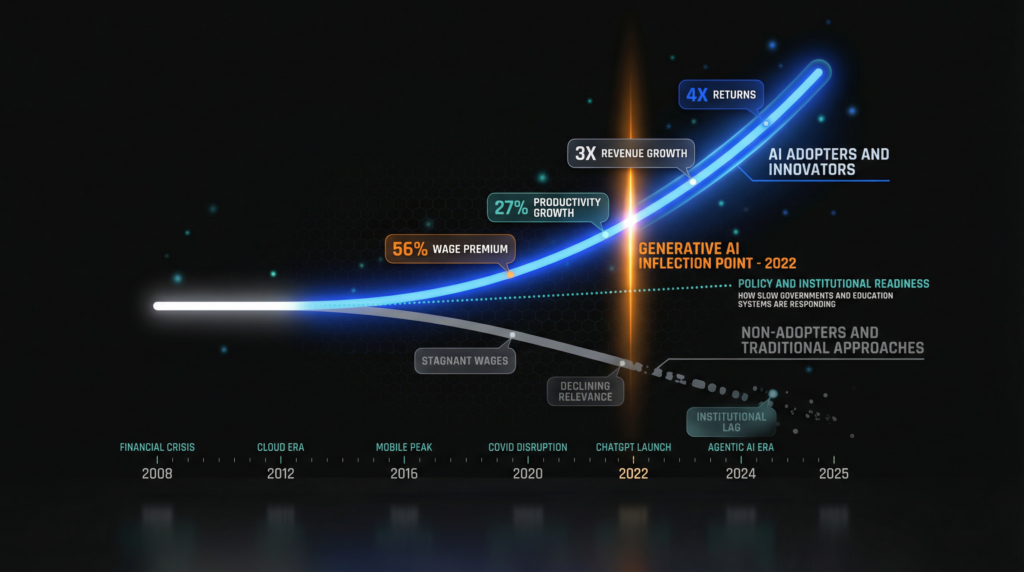
The adoption divide is real and growing. According to BCG’s 2025 AI at Work survey, frontline employees have hit what they call a “silicon ceiling”—with only half of them regularly using AI tools. Meanwhile, leadership teams and technical departments are racing ahead, creating an internal acceleration gap within organizations that mirrors the broader societal divide.
The skills premium is exploding. Jobs requiring AI fluency now command a 56% wage premium, up from just 25% the previous year. That’s not a gradual increase—that’s a fundamental restructuring of how the labor market values human capital.
The displacement timeline is accelerating. MIT researchers have found that AI can already replace nearly 12% of the U.S. labor market, concentrated in finance, healthcare, and professional services. And this is just the beginning—agentic AI systems that can operate with increasing autonomy are already being piloted by one in four companies using generative AI.
The productivity gap is widening. Since 2022, productivity growth has nearly quadrupled in AI-exposed industries—from 7% to 27%. Industries leveraging AI are seeing three times higher revenue growth per employee than those that aren’t.
What does this mean in practical terms? It means the distance between AI adopters and non-adopters is growing at an unprecedented rate. It means the economic advantages compound over time. And it means that every month of inaction puts you further behind.
Equal Parts Optimist and Pessimist
My deep experience with business and investor who’s educational background focused specifically on AI, Computer Science, Economics and Finance, and my fascination with the broader economic engine has given me what I consider a realistic—if sometimes uncomfortable—perspective on where things are heading. I’m both an optimist and a pessimist about AI, and I think both perspectives are essential.
The optimist in me sees transformational potential. AI is democratizing capabilities that were once reserved for elite institutions with massive budgets. A solo entrepreneur today can access analytical tools, content creation capabilities, and automation systems that rival what Fortune 500 companies had access to just five years ago. The productivity gains are real. The creative possibilities are expanding. The ability to solve problems at scale is unprecedented.
The pessimist in me sees a looming crisis that our institutions are completely unprepared for.
We are on the precipice of a major unemployment crisis—especially if people don’t use their free time and a portion of their work time to get educated and stay on the frontier of this space as it evolves. The K-shaped economic recovery we’ve been experiencing since 2008 is about to become a K-shaped economic revolution, where a smaller and smaller portion of the population captures an ever-larger share of the gains.
I look at the data showing that 78% of AI users bring their own tools to work without formal organizational approval, while only 5.4% of firms have formally adopted generative AI. That gap between individual initiative and institutional readiness is a warning sign. It means most organizations are missing the opportunity to systematically capture productivity gains. It means workers who aren’t self-motivated to learn are being left behind by their more proactive colleagues.
And I don’t see the crucial safeguards or educational opportunities necessary for the broader majority of people to benefit from this transition. We’re building the most powerful technology in human history while the majority of our educational institutions, workforce development programs, and policy frameworks remain stuck in paradigms designed for the 20th century.
The Historical Context Most People Are Missing
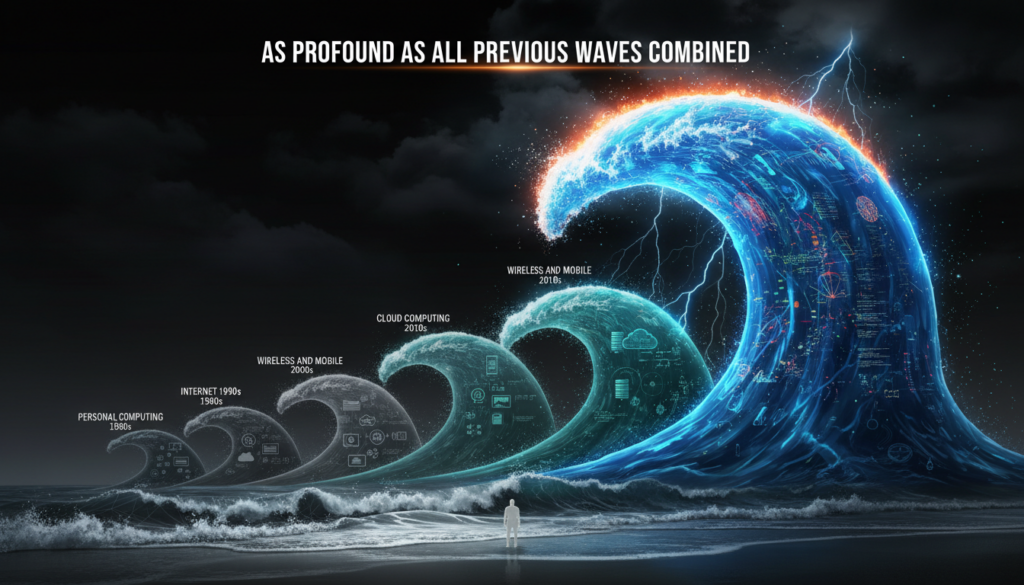
I’ve witnessed every major technology wave of the personal computing era: the PC revolution, the internet transformation, the wireless expansion, the cloud migration, the mobile explosion. Each one created winners and losers. Each one required adaptation and learning. Each one felt disruptive at the time.
What I can tell you with confidence is that AI is likely to be as profound as all of them combined over the coming decades.
That’s not a prediction I make lightly. It’s based on understanding the fundamental nature of what AI represents: not just a new tool, but a new form of intelligence that can be applied to virtually every domain of human activity. Unlike previous technologies that enhanced specific capabilities, AI has the potential to enhance—or replace—cognitive work across every industry, every function, every role.
And I don’t see any reason for it to slow down. The compute is getting cheaper. The models are getting more capable. The applications are getting more practical. The investment is accelerating. The talent is concentrating in organizations that understand what’s happening.
What I’ve Done—And What You Should Consider
I’ve taken drastic and radical steps to completely reengineer my companies and transform myself into an AI-first, automation-first innovator and executive. This wasn’t a gentle transition—it was a wholesale reimagining of how I work, how my teams operate, and how my companies create value.
At Savanti Investments, we built our quantitative investment strategies and entire business model around AI from the ground up. Our proprietary QuantAI™ and SavantTrade™ platforms leverage machine learning for alpha generation, risk management, and portfolio optimization. We didn’t retrofit AI onto existing processes—we designed our processes and software to incorporate AI capabilities from day one.
In my digital marketing efforts, I’ve transformed all systems of the traditional digital marketing stack to leverage AI-driven automation that would have been impossible just a few years ago. The content strategies, analytics pipelines, and campaign optimization systems used today bear little resemblance to what I was doing just several years ago.
This transformation wasn’t comfortable. It required unlearning habits that had served me well for decades and personal circumstances made it exponentially risker. It required investing significant time and resources into understanding and staying on top of new technologies rather than just delegating that work to others. It required making difficult decisions about which legacy approaches to abandon and which new capabilities to prioritize.
But I believe it’s going to be very clear that the companies and executives who embrace this AI-first mindset will succeed wildly—while many others who don’t will face extreme pain as their competitors take market share and capitalize on their hesitation.
The Choice You’re Making Right Now
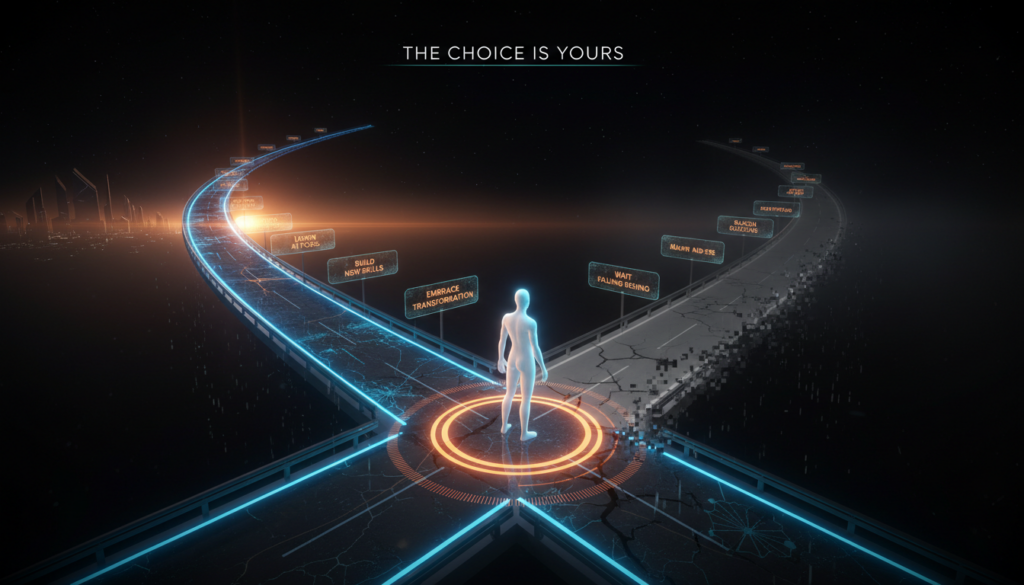
Every day that passes without engaging with AI is a day you fall further behind. Not because you need to become a machine learning engineer—but because AI fluency is becoming as fundamental to professional success as computer literacy was in the 1990s.
Here’s what I’ve learned from watching technology transformations over three decades:
The early adopters don’t just get a head start—they shape the trajectory. They develop intuitions that late adopters never acquire. They build networks with other innovators. They make mistakes early when the stakes are lower. They compound their advantages over time.
Institutional preparation always lags individual initiative. If you’re waiting for your company to develop an AI strategy, you’re already behind. If you’re waiting for schools to teach your kids AI skills, you’re already behind. The individuals who thrive in transitions are the ones who take responsibility for their own adaptation.
The transformation is faster than you think but slower than headlines suggest. We’re not going to wake up tomorrow in a world where AI has replaced all jobs. But we’re also not going to have the luxury of a decade-long transition period to figure things out. The changes are happening now, and they’re accelerating.
A Call to Action
I very much worry about the future—not because I doubt the potential of AI to create abundance, but because I see how poorly we’re preparing the majority of people to participate in that abundance.
The already advancing K-shaped economic system is benefiting a smaller portion of the population year after year. The top few percent of the globe is accumulating wealth while the rest of the population struggles to meet basic needs and feels less and less optimistic about the future.
AI could accelerate that divergence—or it could be the tool that finally democratizes opportunity at scale. Which path we take depends on choices being made right now, by individuals, by leaders, by institutions.
My commitment is to continue building companies that demonstrate what’s possible when you embrace AI as a core capability rather than an afterthought. My goal is to share what I’m learning with those interested. My commitment is to advocate for the policies, educational programs, and institutional changes necessary to ensure this technology benefits more than just the technological elite.
But ultimately, your future in the AI age depends on choices you make yourself. No one else can make them for you.
The acceleration gap is real. The question is which side of it you’re going to be on.
If you’d like to continue this conversation, I welcome you to connect with me on social or reach out via the contact form. I’m always interested in hearing from fellow travelers navigating this unprecedented moment in technological history.