The Rise of ‘Sovereign AI’: How Palantir and Nvidia are Building the Future of Secure, On-Premise AI
On March 12, 2026, Palantir Technologies and NVIDIA announced a partnership that could reshape the global AI landscape. And it’s one every leading CEO integrating AI in their business should be thinking deeply about. Not the partnership necessarily, but how AI, Data, Privacy, Security, and AI Inference run and operate within their business. Together, they’re delivering a complete AI Operating System Reference Architecture—a turnkey solution for nations and enterprises to build AI capabilities entirely within their own borders. The market opportunity? A staggering $600 billion by 2030.
But this isn’t just another tech partnership. It’s a response to a fundamental tension in the AI age: How do you harness the transformative power of artificial intelligence when your most sensitive data can’t—and shouldn’t—leave your jurisdiction?
Welcome to the era of Sovereign AI, where the future of intelligence is local, controlled, and increasingly, a matter of national security.
What’s Happening: The Sovereign AI Revolution
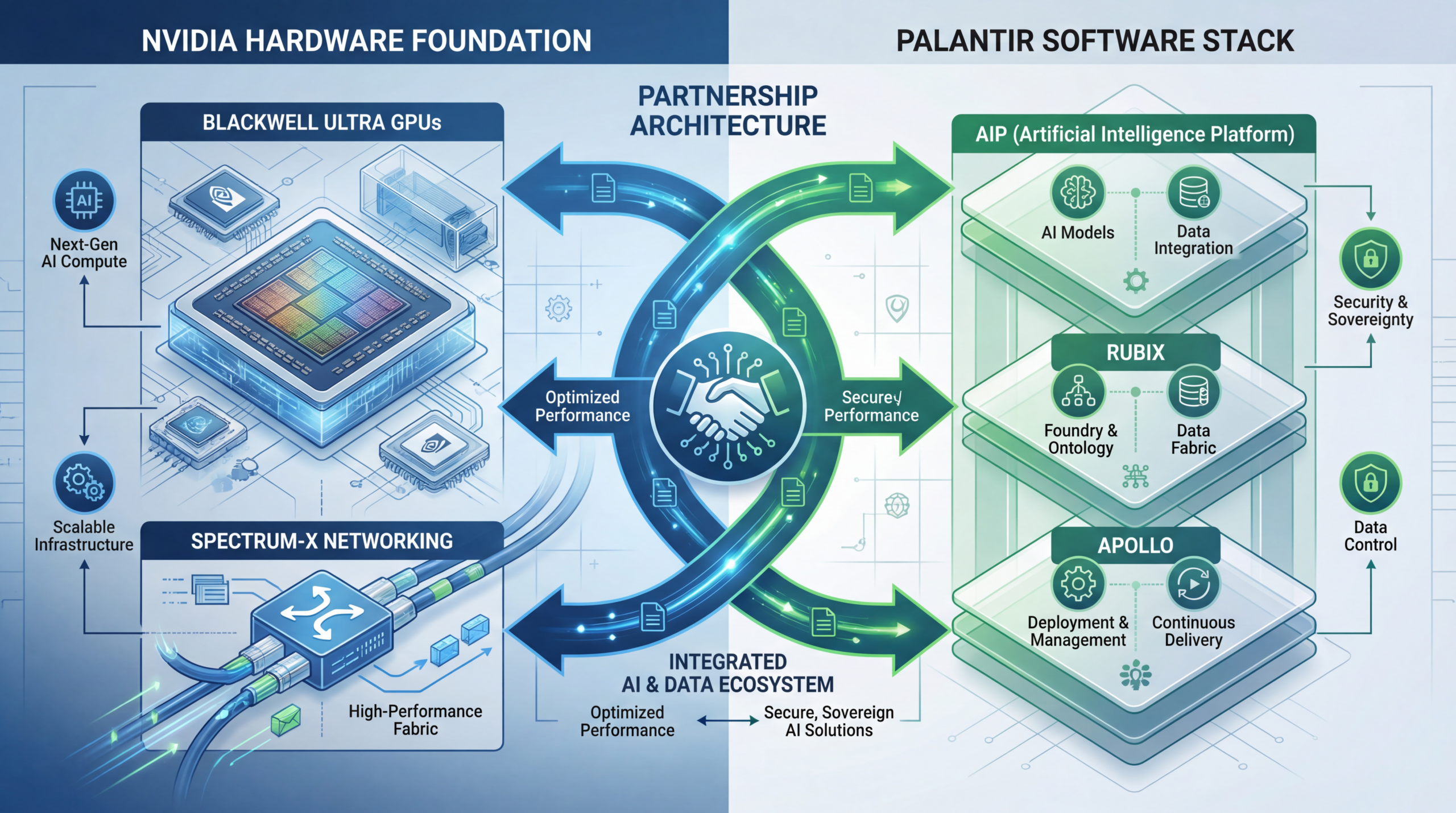
The Palantir-NVIDIA collaboration centers on their AI Operating System Reference Architecture (AIOS-RA), a production-ready blueprint for building sovereign AI datacenters. At its hardware core are NVIDIA Blackwell Ultra systems—each packing eight Blackwell Ultra GPUs interconnected with Spectrum-X Ethernet networking, optimized for both large-scale training and high-performance inference.
Layered on top is Palantir’s comprehensive software stack. The Palantir Compute Infrastructure runs on a hardened Kubernetes substrate, supporting core services from its Foundry platform. Management is unified through Rubix, a zero-trust Kubernetes solution, and Apollo, an autonomous deployment platform that automates updates across the entire infrastructure. The centerpiece is Palantir’s Artificial Intelligence Platform (AIP), which securely connects large language models to an organization’s proprietary data and operational systems—all without that data ever leaving a trusted environment.
This partnership isn’t happening in isolation. Microsoft has been enhancing its sovereign cloud offerings with Azure Local disconnected operations, allowing organizations to run mission-critical infrastructure and large AI models completely detached from the public cloud. Hewlett Packard Enterprise is promoting its “sovereign-by-design” GreenLake platform with air-gapped deployments for private cloud and AI factories.
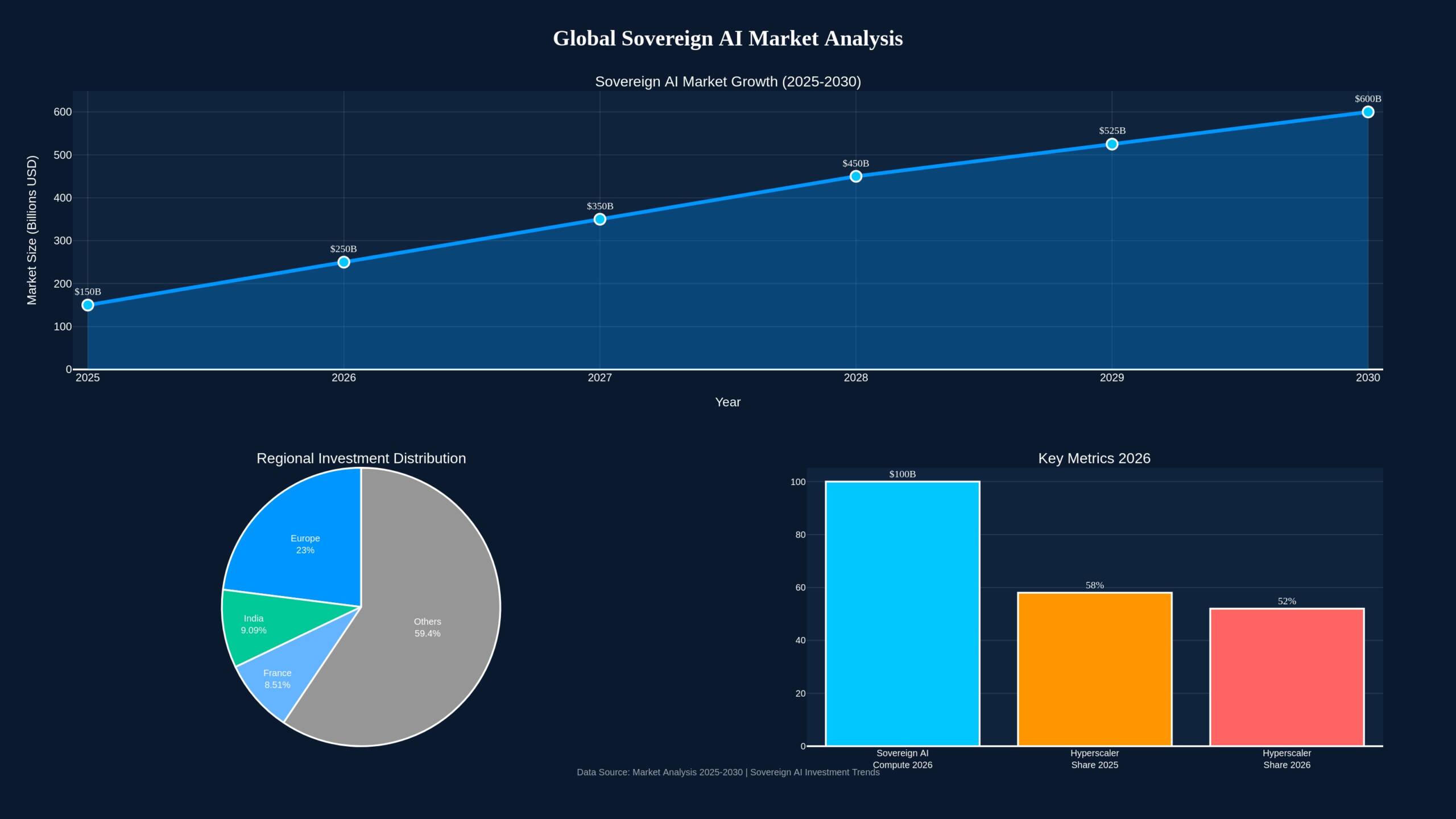
The numbers tell the story of explosive growth. The sovereign AI market is projected to expand from approximately $150 billion in 2025 to $600 billion by 2030. Investment in sovereign AI compute alone is forecast to reach nearly $100 billion in 2026. This surge is reshaping global AI capital expenditure, which is expected to hit $480 billion in 2026. Notably, the dominance of hyperscale cloud providers—Microsoft, Amazon, Alphabet, and Meta—is declining, from 58% of AI spending in 2025 to a projected 52% in 2026. Sovereign and enterprise buyers are claiming an increasing share, expected to account for 17% of global AI capex in 2025.
The geopolitical context adds urgency to this shift. The EU AI Act has established comprehensive legal frameworks for data governance. Meanwhile, recent intelligence reports indicate that state actors, including Iran, have publicly identified the infrastructure of major U.S. technology companies—including Palantir, NVIDIA, Microsoft, Google, Oracle, and IBM—as legitimate targets. Specific corporate offices and data centers in Israel, Dubai, and Abu Dhabi have been highlighted. This transforms sovereign AI from a regulatory compliance issue into a component of national defense strategy.
Why It Matters: The Case for Digital Autonomy
The drive toward sovereign AI is powered by three converging forces: security imperatives, regulatory mandates, and strategic independence.
Security and Control
For organizations handling sensitive data—whether in defense, finance, or healthcare—the ability to maintain complete control over where data resides and how it’s processed is non-negotiable. Air-gapped deployments offer maximum security by physically isolating systems from external networks. Real-world implementations are already operational: CGI developed a secure, AI-supported “knowledge agent” for NATO that runs on a sovereign cloud architecture with air-gapped infrastructure, ensuring complete isolation for maximum security.
In the private sector, financial institutions are exploring sovereign AI to maintain strict control over proprietary trading models and sensitive financial data. Legal and notarial services are adopting these architectures to handle confidential client information. Alias Robotics has developed `alias2-mini`, a compact cybersecurity AI model designed specifically for sovereign, on-premise deployment, allowing organizations to run advanced threat detection locally while ensuring full data sovereignty.
Regulatory Compliance
The regulatory landscape is a primary catalyst for sovereign AI adoption. The EU AI Act’s Article 10, titled “Data and Data Governance,” mandates that high-risk AI systems be trained, validated, and tested using high-quality datasets that are relevant, representative, error-free, and complete. This provision effectively extends the EU’s legal jurisdiction over the data used to build AI models, regardless of where developers are located.
The AI Act doesn’t operate in isolation. It works in conjunction with the General Data Protection Regulation (GDPR), which establishes a rights-based, extraterritorial approach to personal data processing. The Data Governance Act supports data circulation within the EU while restricting cross-border transfers that could contravene EU law. Together, these regulations create a formidable legal framework asserting sovereign control over both data and algorithms touching the EU market.
Strategic Independence
Beyond compliance, sovereign AI represents a strategic bet on technological autonomy. Nations are recognizing that dependence on foreign cloud providers creates vulnerabilities—not just to surveillance or data breaches, but to geopolitical leverage. Building domestic AI capabilities reduces this dependency and fosters local innovation ecosystems.
As someone who’s built a leading company at the intersection of in AI and Finance—Savanti’s QuantAI institutional investment fund platform—I’ve witnessed firsthand how data governance can make or break enterprise AI adoption. When we developed SavantTrade, navigating the complex web of financial regulations across jurisdictions taught me that compliance isn’t a checkbox exercise. It’s foundational architecture. The institutions that succeed with AI are those that build sovereignty into their systems from day one, not as an afterthought.
Expert Analysis: The Architecture of Sovereignty
Understanding sovereign AI requires looking beyond the marketing to the technical and economic realities.
Technical Deep Dive
The architecture of sovereign AI is built on several core principles. First, localized compute infrastructure ensures all AI workloads are processed on hardware within approved data centers or jurisdictions. Second, secure data and model storage protects all assets—training data, model artifacts, checkpoints—both at rest and in transit, with full visibility into their physical location. Third, isolated network topologies prevent unauthorized data exfiltration, ranging from segmented networks to fully air-gapped environments.
Critically, many sovereign AI frameworks advocate for open, modular tooling to avoid vendor lock-in. This approach leverages open-source orchestration platforms and containerized deployments, supporting a consistent operational model across diverse hardware and software environments.
Palantir’s AIP exemplifies this approach. It creates a secure bridge between large language models and an organization’s proprietary data, enabling context-aware AI applications while ensuring data never leaves the trusted environment. This is fundamentally different from cloud-based AI, where data typically moves to where the compute is. In sovereign AI, the compute comes to where the data must remain.
The Economics
The financial implications of sovereign AI are substantial and complex. While the market opportunity is massive, the cost premium is real. IDC predicts that the need to split AI stacks across different sovereign zones due to regulatory fragmentation could triple integration costs for multinational corporations by 2028.
The shift in spending patterns is already visible. In 2026, global AI capital expenditure is projected to reach $480 billion, with sovereign and enterprise buyers claiming an increasing share. Europe held the largest share of the sovereign cloud market in 2025 at 23%, with specific regional forecasts highlighting India’s sovereign cloud market reaching $9.09 billion in 2026 and France’s hitting $8.51 billion.
This investment is flowing into the full stack: not just AI compute and high-bandwidth memory, but also essential industrial infrastructure like advanced networking, cooling, and power systems. The capital intensity is formidable, raising questions about which nations and organizations can afford to compete.
Use Cases in Action
Sovereign AI is moving from concept to reality across multiple sectors. CGI helped a Swedish government agency build a secure, internal AI assistant running on open-source infrastructure, enabling AI adoption in compliance with strict national regulations. In finance, institutions are using sovereign architectures to protect proprietary trading algorithms and comply with banking regulations. In cybersecurity, on-premise AI models are enabling real-time threat detection without exposing security intelligence to external networks.
At my AI Automation Firm, we’ve approached data sovereignty as a core design principle for our enterprise clients. The balance between AI innovation and regulatory compliance isn’t a trade-off—it’s an integration challenge. And at my hedge fund, Savanti Investments, Sovereign AI has been crucial to building QuantAI for institutional investments, for security, control, and ensuring data alignment; they’re being prudent. The question isn’t whether to embrace AI, but how to do so without compromising the data governance that regulators and stakeholders demand.
Real-World Implications: Who Wins, Who Loses
The sovereign AI revolution creates clear winners and losers, though the picture is more nuanced than it first appears.
Winners
Nations with strong regulatory frameworks, particularly the EU, are positioning themselves as leaders in defining the rules of the AI age. Enterprise software companies like Palantir, Microsoft, and HPE are capitalizing on demand for integrated sovereign solutions. Chip manufacturers, especially NVIDIA and AMD, benefit from the massive compute infrastructure buildout. Regulated industries—finance, healthcare, defense—gain the ability to adopt AI capabilities while maintaining compliance.
Regions investing heavily in domestic compute capacity are building strategic advantages. India’s $9.09 billion and France’s $8.51 billion sovereign cloud investments in 2026 represent bets on technological autonomy that could pay dividends for decades.
Losers
Hyperscale cloud providers face market share erosion as sovereign and enterprise buyers build their own infrastructure. Startups unable to afford sovereign infrastructure may find themselves locked out of regulated markets. Consumers could face higher prices as reduced competition in sovereign markets drives up costs. Global AI innovation risks fragmentation as “splinter clouds” emerge along national and regional lines.
The Contrarian View
Not everyone is convinced sovereign AI is the right path. Bill Whyman, a senior adviser at the Center for Strategic and International Studies, warns against nationalistic “splinter clouds.” He argues that sovereign controls don’t inherently provide superior technical security and can lead to slower growth, reduced innovation, and less competitive national economies. Historical track records of sovereign infrastructure projects—many becoming stranded investments—support this skepticism.
The economic critique is sharp: protectionist policies favoring local data centers reduce market competition, potentially inflating prices and stifling startups. Many enterprise decision-makers still prioritize price, performance, and reliability over sovereignty when selecting vendors, suggesting a disconnect between policy ambitions and business realities.
There’s also significant public skepticism toward key corporate actors. Palantir, in particular, faces criticism due to its deep ties to intelligence agencies like the CIA and Mossad. Campaigns protesting its involvement in public services, such as the UK’s NHS, reflect widespread concern over data privacy and corporate surveillance. Achieving true digital sovereignty requires not just technological capability but public trust—a challenge that remains unresolved.
Future Outlook: The Hybrid Path Forward
The most likely scenario isn’t a binary choice between sovereign AI and cloud AI, but a hybrid model that leverages both strategically.
The Likely Scenario
McKinsey advocates for using sovereign AI for critical applications while leveraging global models for other purposes. The EU’s strategy exemplifies this approach: combining binding regulations with open-source initiatives like GAIA-X and EuroStack, which aim to create federated, interoperable cloud infrastructure under European control. The “AI factories” initiative is designed to significantly boost the EU’s domestic compute capacity while maintaining connections to global innovation networks.
This hybrid approach acknowledges practical realities. Not every workload requires sovereign infrastructure. The key is intelligent classification: understanding which data and applications demand sovereign control and which can safely leverage the scale and efficiency of global cloud providers.
Key Challenges Ahead
Significant obstacles remain. Many regions face talent gaps in AI engineering and operations. Domestic chip manufacturing capacity is concentrated in the US, Taiwan, and China, creating dependencies that undermine true sovereignty. Balancing innovation with control requires sophisticated governance frameworks that many nations are still developing.
Perhaps most concerning are the physical security threats. The recent designation of tech infrastructure as legitimate targets by state actors elevates the stakes dramatically. Protecting billions of dollars in data center investments requires military-grade security, fundamentally changing the risk calculus for sovereign AI deployments.
What This Means for Entrepreneurs and Businesses
For business leaders, the sovereign AI era demands strategic clarity. Start by assessing your data sensitivity and regulatory requirements. Not every organization needs sovereign infrastructure, but those in regulated industries or handling sensitive data should be planning now.
When evaluating sovereign versus cloud AI, consider:
– Data sensitivity: What are the consequences of data exposure or foreign access?
– Regulatory requirements: What are your compliance obligations across jurisdictions?
– Performance needs: Do you require low-latency, high-throughput processing?
– Cost tolerance: Can you absorb the premium for sovereign infrastructure?
– Strategic importance: Is AI capability a competitive differentiator or national security concern?
The importance of modular, portable architectures cannot be overstated. Avoid vendor lock-in by building on open standards and containerized deployments. This flexibility allows you to move workloads between sovereign and cloud environments as requirements evolve.
There’s also significant opportunity in building sovereign AI solutions for specific verticals. The market is still nascent, and specialized providers who understand the unique requirements of particular industries or regions can capture substantial value.
Having worked across continents—from Silicon Valley to European financial centers to emerging markets—I’ve seen how different regions approach technology governance. The future isn’t one-size-fits-all. It’s about intelligent choice architecture: understanding your constraints, assessing your options, and building systems that balance innovation with control. The entrepreneurs who succeed in the sovereign AI era will be those who see regulation not as a barrier but as a design parameter.
Control in the Age of Intelligence
Sovereign AI is no longer a theoretical concept or distant future. It’s here, driven by a $600 billion market opportunity and geopolitical necessity. The Palantir-NVIDIA partnership announced in March represents a watershed moment—the delivery of production-ready infrastructure that makes sovereign AI accessible to nations and enterprises worldwide.
This isn’t just about where your data lives. It’s about who controls the future of intelligence. As AI systems become more powerful and more deeply integrated into critical infrastructure, the question of sovereignty becomes existential. Can nations maintain autonomy when their most important decisions are made by algorithms running on foreign infrastructure? Can enterprises compete when their proprietary data and models are exposed to competitors or adversaries?
The answers will shape the next decade of technological development and geopolitical competition. Businesses and nations must make strategic choices now—not just about technology, but about values, governance, and the kind of future they want to build.
In an age of AI, sovereignty isn’t just political. It’s computational. And the architecture you choose today will determine your autonomy tomorrow.
Frequently Asked Questions
Q: What is Sovereign AI?
Sovereign AI refers to artificial intelligence systems that are developed, deployed, and operated entirely within a nation’s or organization’s own infrastructure, ensuring complete control over data, models, and operations without reliance on foreign cloud providers.
Q: Why did Palantir and Nvidia partner on Sovereign AI?
They partnered to deliver a complete AI Operating System Reference Architecture (AIOS-RA) that enables nations and organizations to build production-ready AI datacenters with full data sovereignty, addressing the $600B market opportunity driven by regulatory requirements and security concerns.
Q: How much will the Sovereign AI market be worth?
The sovereign AI market is projected to grow from approximately $150 billion in 2025 to $600 billion by 2030, with $100 billion in sovereign AI compute investment expected in 2026 alone.
Q: What are the main use cases for Sovereign AI?
Primary use cases include government services, defense and national security, financial services (trading and banking), healthcare (patient data protection), and cybersecurity, where data sensitivity and regulatory compliance are paramount.
Q: Is Sovereign AI more expensive than cloud AI?
Yes, sovereign AI typically carries a cost premium due to the need for dedicated infrastructure, specialized security measures, and potentially tripled integration costs for multinational organizations managing multiple sovereign zones.
Q: What are the risks of Sovereign AI?
Key risks include high costs, potential creation of inefficient “splinter clouds,” vendor lock-in, geopolitical threats to physical infrastructure, stranded assets from overcapacity, and reduced innovation due to fragmentation.
Regulatory Disclosure:
This article is for informational and educational purposes only and does not constitute investment advice, financial advice, trading advice, or any other sort of advice. The views expressed are those of the author and do not represent the views of any affiliated organizations. Investing in securities involves risk, including the possible loss of principal. Past performance is not indicative of future results. Readers should conduct their own research and consult with qualified financial, legal, and tax professionals before making any investment decisions.
Regulation D Notice: Certain investment opportunities mentioned may be offered pursuant to Regulation D of the Securities Act of 1933 and are available only to accredited investors as defined in Rule 501 of Regulation D.