

Disclaimer: This article is for educational and informational purposes only and is not investment advice. The views expressed are those of the author and do not constitute recommendations to buy or sell any securities or make any investment decisions.
The Quiet Revolution That’s Reshaping Corporate America
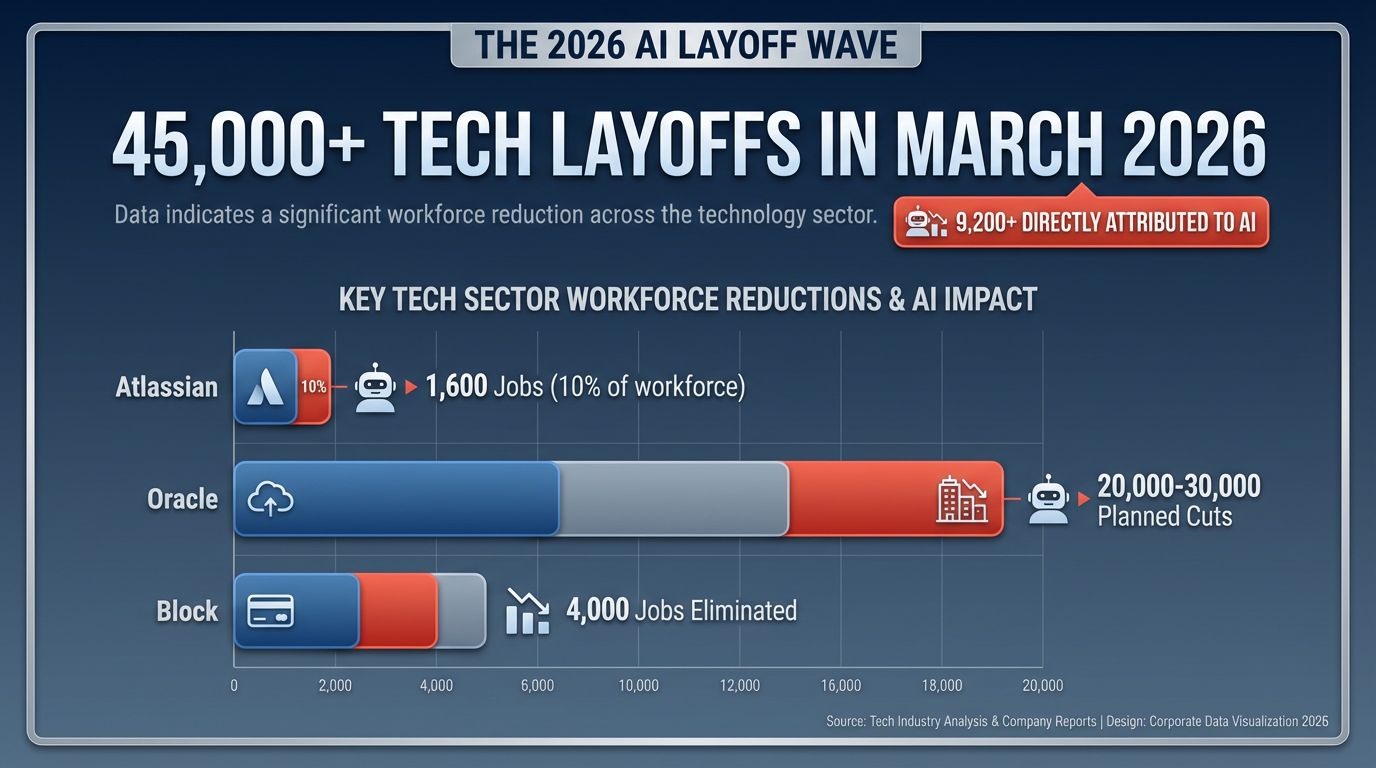
In the span of just three weeks in March 2026, more than 45,000 technology workers received termination notices. But this wasn’t your typical economic downturn. The pink slips came with a new, chilling justification: “AI-driven restructuring.” Atlassian cut 1,600 employees—10% of its workforce. Oracle announced plans to eliminate up to 30,000 positions. Block, the fintech giant behind Square and Cash App, slashed 4,000 roles, with CEO Jack Dorsey bluntly stating that AI had “fundamentally” changed how companies are built.
This isn’t speculation about a distant future. This is happening now. And it marks a watershed moment in the relationship between human labor and machine intelligence.
For years, we’ve debated whether AI would replace jobs or create them. That debate is over. The answer is both—and the transition is far more brutal, swift, and transformative than most economists predicted. What we’re witnessing in 2026 is the first major wave of explicit AI-driven workforce displacement, and it’s forcing us to confront uncomfortable questions about the future of work, the distribution of economic gains, and the very structure of capitalism itself.

What’s Happening: The Great AI Layoff Wave
The numbers are staggering. In March 2026 alone, over 9,200 tech layoffs were directly attributed to AI and automation. If this pace continues, we’re on track for more than 264,000 tech job losses by year-end—eclipsing the pandemic-era restructuring of 2020-2021.
But it’s not just the scale that’s unprecedented—it’s the rationale. Companies are no longer hiding behind euphemisms like “organizational efficiency” or “strategic realignment.” They’re explicitly stating that AI can now do what humans used to do, faster and cheaper.
Consider Atlassian’s announcement. The Australian software giant, maker of collaboration tools like Jira and Confluence, didn’t frame its 1,600 layoffs as a response to market conditions. Instead, it positioned them as a necessary step to “self-fund further investment in AI.” The company simultaneously replaced its Chief Technology Officer with what it called “next-generation AI talent.” The message was unmistakable: human expertise is being systematically devalued in favor of machine intelligence.
Block’s cuts were even more dramatic. The company eliminated 40% of its global workforce—over 4,000 people—with Jack Dorsey stating that AI-driven productivity improvements had fundamentally altered the company’s operational structure. This wasn’t about trimming fat; it was about redesigning the entire organism.
And then there’s Oracle, which plans to cut between 20,000 and 30,000 employees while simultaneously investing $8-10 billion in AI infrastructure. The trade-off couldn’t be clearer: human capital is being liquidated to fund machine capital.
Why It Matters: The Technology Behind the Transformation
What’s driving this sudden acceleration? The answer lies in the maturation of agentic AI—a qualitative leap beyond the generative AI tools that dominated headlines in 2024-2025.
Early generative AI was impressive but limited. ChatGPT could write an email or debug a function, but it required constant human direction. It was a sophisticated assistant, not an autonomous worker.
Agentic AI is different. These systems can reason, plan, and autonomously execute complex, multi-step processes to achieve high-level goals. Instead of responding to a single prompt, they can deconstruct a problem, invoke a series of tools, interpret results, and iterate on their approach with minimal human intervention.
By 2026, agentic AI has evolved from theoretical concept to practical deployment. These systems can now perform a first-pass execution of the entire software development lifecycle (SDLC)—from analyzing feature feasibility during planning, to implementing code, expanding test coverage during validation, and surfacing potential risks during review. What previously required weeks of human coordination now happens in continuous, automated workflows.
Anthropic CEO Dario Amodei wasn’t exaggerating when he suggested that AI could handle nearly all software engineering work “end-to-end” within 6-12 months. Meta CEO Mark Zuckerberg predicted that AI would be writing the majority of his company’s code by mid-2026. These aren’t aspirational statements—they’re operational realities.
The structural difference is profound: AI has moved from tool to team member. And unlike human team members, AI agents don’t require salaries, benefits, vacation time, or sleep.
Expert Analysis: Intelligence Arbitrage and the New Corporate Playbook
What we’re witnessing is the emergence of what I call “intelligence arbitrage”—the ability to achieve high-quality outcomes with dramatically lower marginal costs in time and labor by leveraging AI.
This represents a fundamental departure from traditional operating models. For decades, scaling a business meant proportional increases in headcount. More customers required more support staff. More products required more engineers. More transactions required more analysts.
That equation is breaking down. Companies are discovering they can scale revenue without scaling headcount—or even while reducing it. This is the core insight driving the 2026 layoff wave.
At Savanti Investments, we’ve been tracking this trend closely through our QuantAI™ platform, which uses machine learning to identify inflection points in market behavior. Our models flagged a significant shift in corporate capital allocation patterns starting in Q4 2025: a sharp divergence between R&D spending (up) and personnel costs (down). This wasn’t a cost-cutting cycle—it was a strategic reallocation from human capital to machine intelligence.
The implications for investors are profound. Companies that successfully execute this transition will see dramatic margin expansion. Those that fail—or move too slowly—will face existential competitive pressure. We’re already seeing this play out in market valuations. Atlassian’s stock rose 4% in extended trading following its layoff announcement, signaling investor approval of the AI pivot.
But there’s a darker interpretation. Some analysts, including those at Deutsche Bank, suggest that “AI redundancy washing” is becoming a significant feature of 2026—companies using AI as a convenient justification for layoffs that are actually driven by more mundane factors like over-hiring during the pandemic or failed strategic bets.
OpenAI CEO Sam Altman has been particularly vocal about this, suggesting that many companies are using AI as a scapegoat for traditional business decisions. The truth likely lies somewhere in between: AI is a real and transformative force, but its current capabilities may not fully account for the scale of announced layoffs.

Real-World Implications: The Human Cost of the AI Transition
Behind every statistic is a human story. And the stories emerging from the 2026 layoff wave are deeply troubling.
Employee anxiety about AI-driven job loss has surged from 28% in 2024 to 40% in 2026. A Resume Now report found that 60% of U.S. workers expect AI to eliminate more jobs than it creates in the coming year, and one in five personally knows someone who has lost a job to AI.
The psychological impact is compounded by the manner in which these layoffs are conducted. Unions like Professionals Australia have criticized companies such as Atlassian for lack of prior consultation, arguing that experienced professionals are being made redundant without transparency or respect.
But the deeper issue is structural. The current social safety net—unemployment insurance, retraining programs, career counseling—was designed for a different era of employment. It assumes that job loss is temporary and cyclical, that workers can be retrained for new roles in the same industry, and that economic growth will eventually create replacement jobs.
None of those assumptions hold in the age of agentic AI.
The displacement is not temporary—it’s permanent. The skills gap is not bridgeable through short-term retraining—it requires fundamental re-education. And the new jobs being created often require advanced technical skills that displaced workers don’t possess and may never acquire.
This has intensified discussions around more radical solutions, such as Universal Basic Income (UBI). IMF Managing Director Kristalina Georgieva stated that AI is “hitting the labor market like a tsunami,” and most countries and businesses are unprepared for its impact.
There’s also the risk of what some economists call “ghost GDP”—economic output generated by AI that primarily benefits the owners of computing power and capital, rather than circulating through the broader consumer economy via wages. If productivity gains aren’t shared and large segments of the population become unemployable, it could lead to a contraction in consumer demand and potential economic instability.
This is not a theoretical concern. Companies like UPS have eliminated 48,000 jobs through automation. Salesforce cut 4,000 customer support roles in 2025 after AI began performing 50% of the work. The scale of displacement is real, and it’s accelerating.
The Contrarian Case: Why AI Might Create More Jobs Than It Destroys
Amid the doom and gloom, there’s a compelling contrarian narrative that deserves serious consideration.
The World Economic Forum’s Future of Jobs Report projects that while AI and automation may displace 92 million roles by 2030, they will also create approximately 170 million new ones—a net global gain of 78 million jobs.
This perspective frames the current disruption not as an endpoint but as a painful but necessary redistribution of labor toward new, yet-to-be-defined roles centered on human-machine collaboration, AI ethics, and the management of intelligent systems.
History offers some support for this view. The Industrial Revolution displaced millions of agricultural workers, but it ultimately created far more jobs in manufacturing, services, and knowledge work. The computer revolution eliminated entire categories of clerical work, but it spawned the entire information technology sector.
The challenge is that these transitions are never smooth, and they can take decades. The workers displaced by automation in the 1980s didn’t necessarily benefit from the tech boom of the 2000s. The question is whether we can manage this transition more humanely and equitably than previous technological revolutions.
There’s also the “AI Employment Paradox”: a net increase in jobs coexisting with a severe skills gap and a highly polarized labor market. LinkedIn data shows that workers with AI-related skills are hired at much higher rates and command significant wage premiums. But the acquisition of these skills is not evenly distributed, favoring those already in professional and technical roles.
This could create a bifurcated economy with high demand for a small pool of AI-savvy talent and shrinking opportunities for everyone else—unless massive and effective reskilling initiatives can bridge the gap.
Another contrarian perspective argues that the entire debate over job numbers misses the point. AI’s primary impact is not on labor automation but on the fundamental transformation of business models. The real disruption comes from AI’s ability to attack “friction-based value”—any business model that profits from delays, opacity, or manual coordination.
From this standpoint, the threat is not job loss itself, but the loss of business relevance. The focus for leaders and workers should be on identifying what remains essential and valuable in a world where intelligence is abundant.
Future Outlook: Navigating the 2027-2030 Transition
Looking beyond the immediate disruption of 2026, the period between 2027 and 2030 will be one of continued and deepening transformation.
By 2030, an estimated 70% of companies will have adopted at least one form of AI technology, contributing a projected $13 trillion to the global economy. The World Economic Forum estimates that 39% of core job skills will change by 2030. The demand for AI fluency has already increased sevenfold in just two years.
The evolution of AI’s role in the workplace will progress through distinct phases:
- Assistance (2024-2026): AI supports discrete tasks—writing code snippets, generating reports, answering customer queries.
- Augmentation (2027-2030): AI agents manage entire multi-step workflows within defined domains, such as autonomously overseeing a CI/CD pipeline or managing a customer support queue.
- Autonomy (2030+): AI systems operate across different domains, making strategic decisions guided by high-level business objectives.
Gartner projects that by the autonomy phase, IT work will be performed 75% by humans augmented with AI and 25% by AI alone, with virtually no tasks being done by humans without AI assistance.
This technological shift will create new economic ecosystems. The immense computational power required for advanced AI is fueling demand for a “new-collar” economy centered on the construction, maintenance, and operation of data centers—requiring a workforce with vocational and technical skills.
At the same time, the jobs least likely to be affected are those that rely on uniquely human traits: teachers, surgeons, senior managers, psychologists, and artists, whose roles are defined by empathy, creativity, complex strategic thinking, and nuanced human interaction.
For investors, this creates both opportunities and risks. At Savanti, we’re using our SavantTrade™ platform to identify companies that are successfully navigating this transition—those that are investing in AI infrastructure while maintaining strong human capital in areas where human judgment remains irreplaceable.
We’re also watching for policy responses. The ultimate scenario will be determined by society’s ability to adapt. Success will require concerted effort from governments, industries, and individuals to invest in lifelong learning, cultivate soft skills that complement AI, and implement proactive policies that can manage this historic transition humanely and equitably.
Conclusion: The Inflection Point
The 2026 AI layoff wave is not just another business cycle. It’s an inflection point—a moment when the theoretical becomes real, when the future arrives ahead of schedule, and when we’re forced to confront the consequences of technologies we’ve created but don’t yet fully understand how to govern.
The companies making headlines today—Atlassian, Oracle, Block—are not outliers. They’re early movers in a transformation that will eventually touch every industry, every company, and every worker.
The question is not whether AI will reshape the labor market. It already is. The question is whether we can manage this transition in a way that distributes the gains broadly, supports those displaced, and preserves the human dignity and purpose that work provides.
At Convirtio, we’re helping businesses navigate this transition by building AI-powered marketing automation that augments human creativity rather than replacing it. The goal is not to eliminate jobs but to elevate them—to free humans from repetitive tasks so they can focus on strategy, creativity, and the uniquely human skills that machines can’t replicate.
That’s the optimistic scenario. But optimism requires action. It requires investment in education and reskilling. It requires thoughtful regulation that balances innovation with worker protection. It requires a social contract that ensures the benefits of AI are shared, not hoarded.
The AI revolution is here. The only question is whether we’ll rise to meet it—or be swept away by it.
Important Disclosures: This article discusses general market trends and is not personalized investment advice. Savanti Investments LLC is a registered investment adviser. Past performance is no guarantee of future results. Investing involves risk, including the possible loss of principal. This content is provided for informational purposes only and does not constitute an offer to sell or a solicitation of an offer to buy any securities. Any investment decisions should be made only after consulting with a qualified financial advisor and reviewing all relevant offering documents. Certain statements in this article may constitute forward-looking statements, which involve risks and uncertainties. Actual results may differ materially from those projected.
For accredited investors interested in learning more about Savanti’s AI-driven investment strategies, please visit savanti.com or contact us directly. All investments are subject to eligibility requirements under Regulation D Rule 506(c).




The Geopolitical Risk Premium: Navigating Financial Markets Amidst the US-Iran Conflict