Important Disclosure: This article is for educational and informational purposes only and is not investment advice. The views expressed are my own and do not constitute a recommendation to buy or sell any security. Please consult with a qualified financial advisor before making any investment decisions.
The Quiet Revolution Happening Behind the Mahogany Doors
While the world obsesses over ChatGPT’s latest party tricks and whether AI will steal our jobs, something far more consequential is unfolding in the marble lobbies and server rooms of Wall Street’s most powerful institutions. JPMorgan Chase just reclassified artificial intelligence from “research and development” to “core infrastructure”—the same category as their payment rails and trading systems. Goldman Sachs has embedded Anthropic engineers inside their operations for six months, building AI agents that can autonomously handle accounting and compliance. This isn’t experimentation anymore. This is re-architecture.
I’ve spent the last decade watching technology reshape finance, first as an observer, then as a participant building Savanti Investments and our quantitative trading platform SavantTrade™. But what’s happening right now—in early 2026—feels different. We’re not just automating tasks. We’re witnessing the birth of what I call Autonomous Finance: a new operating system for capital markets where AI agents don’t just assist bankers—they are the bankers.
And if you’re not paying attention, you’re already behind.
From Algo Trading to Agentic Infrastructure: What’s Really Changing
Let’s start with what this isn’t. This isn’t about high-frequency trading algorithms executing thousands of trades per second—that’s been around since the 1990s. This isn’t about robo-advisors rebalancing portfolios—that’s table stakes in 2026. And this definitely isn’t about some chatbot answering customer service questions.
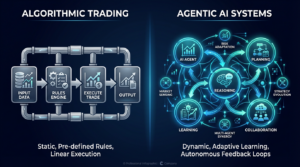
What’s happening is fundamentally different. Traditional algorithmic trading operates on static, rule-based logic: if X happens, do Y. It’s fast, but it’s brittle. Change the market conditions, and you need to manually reconfigure the entire system. It’s like having a very efficient assembly line that can only make one product.
Agentic AI, by contrast, is a dynamic ecosystem of intelligent agents that can reason, plan, learn, and collaborate. Think of it less like an assembly line and more like a team of specialists who can adapt their strategy in real-time based on what they’re seeing.
Here’s a concrete example: At JPMorgan, their OmniAI platform now coordinates over 400 production use cases across the enterprise. An orchestrator agent receives a high-level goal—say, “rebalance this $500 million portfolio based on the latest inflation data”—and then autonomously coordinates a fleet of specialized agents to:
- Gather and validate the latest economic data from multiple sources
- Analyze risk exposure across asset classes
- Propose optimal trades that minimize tax impact and transaction costs
- Execute those trades across multiple venues
- File the required regulatory reports
- Log every decision for audit and compliance review
All of this happens in minutes, not days. And critically, the system learns from each iteration, improving its decision-making over time.
The numbers tell the story. JPMorgan is investing roughly $18 billion annually in technology, with AI as a top priority. They project $1.5 to $2.0 billion in annual business value from AI use cases. Goldman Sachs CEO David Solomon has explicitly stated that the firm’s multi-year reorganization is designed to “constrain headcount growth” through generative AI—a polite way of saying they’re building machines to do what humans used to do.
But here’s what really matters: This is about competitive moats, not just cost savings.
The Data Flywheel and the Great Consolidation
At Savanti, we’ve built our entire investment thesis around what I call the “exponential convergence” of AI, blockchain, and quantitative finance. Our QuantAI™ framework leverages machine learning to identify patterns in market data that human analysts simply can’t see. But even with our sophisticated models, we’re acutely aware of one brutal truth: data is the new oil, and the biggest players have the biggest refineries.
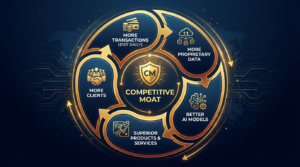
JPMorgan processes over $10 trillion in transactions every single day. That’s not a typo. Ten trillion dollars. Daily. This creates what they call a “data flywheel”—more transactions generate more data, which trains better AI models, which create better products, which attract more clients, which generate more transactions. It’s a virtuous cycle that’s nearly impossible for smaller players to replicate.
Their JADE (JPMorgan Chase Advanced Data Ecosystem) platform provides a unified, real-time data foundation that feeds their AI systems. This isn’t just about having more data—it’s about having proprietary data that no one else can access. When you combine that with cutting-edge AI infrastructure, you create a competitive advantage that compounds over time.
This is why I believe we’re heading toward what I call “The Great Consolidation.” The arms race we’re witnessing isn’t sustainable for everyone. Mid-sized and regional banks are caught in a “legacy debt trap”—they’re spending so much capital maintaining aging systems that they can’t afford to invest in the modern, cloud-native, data-centric infrastructure required to compete in the agentic AI era.
The result? A winner-take-all market where AI leaders like JPMorgan, Goldman Sachs, and a handful of others pull insurmountably ahead, while everyone else either gets acquired or relegated to niche markets.
What Goldman’s Anthropic Partnership Really Means
Let’s talk about Goldman Sachs for a moment, because their strategy reveals something crucial about where this is all heading.
For the past six months, Goldman has had Anthropic engineers embedded inside their operations, co-developing AI agents for two specific areas: accounting for trades and transactions, and client vetting and onboarding. These aren’t glamorous functions—they’re the unglamorous, process-intensive back-office work that’s always been labor-intensive and error-prone.
But here’s the strategic insight: By automating these core operational functions, Goldman isn’t just cutting costs—they’re in-housing capabilities that they used to buy from third-party software providers. This has sent shockwaves through the enterprise SaaS market, with analysts warning of a potential “SaaSapocalypse” where large enterprises build rather than buy solutions.
Think about what this means. If Goldman can build AI agents that handle accounting and compliance better than specialized software vendors, why would they keep paying those vendors? And if Goldman can do it, so can JPMorgan, Bank of America, and every other major institution.
This is the “Agent as a Service” model emerging in real-time. Instead of buying software licenses, firms are building fleets of specialized AI agents that can be deployed across different functions. Need code generation for a new trading platform? Deploy the coding agent. Need in-depth credit analysis? Deploy the credit agent. Need to automate regulatory reporting? Deploy the compliance agent.
At Savanti, we’re watching this trend closely because it has profound implications for how we think about building financial technology. Our Convirtio platform—which helps businesses optimize their digital marketing and conversion funnels—is already incorporating agentic AI principles. We’re not just analyzing data; we’re deploying agents that can autonomously test different strategies, learn from the results, and optimize in real-time.
The lesson from Goldman’s partnership with Anthropic is clear: The future belongs to firms that can orchestrate fleets of specialized AI agents, not just deploy individual models.
The Regulatory Tightrope and the Validation Period
Now, before you think this is all smooth sailing toward an AI-powered utopia, let me inject some reality. The regulators are watching, and they’re not happy about being caught flat-footed.
Both the SEC and FINRA have made it clear that their rules are “technologically neutral”—meaning existing obligations around supervision, risk management, and fiduciary duty apply to AI agents just as they would to human employees. But here’s the problem: How do you supervise an AI agent that’s making thousands of decisions per second based on reasoning processes that even its creators don’t fully understand?
The SEC has already started cracking down on “AI washing”—firms that exaggerate or misrepresent their AI capabilities to investors. They’ve initiated enforcement actions and made it clear that such disclosures are considered material. The Consumer Financial Protection Bureau has ruled that AI systems acting as loan officers must be registered and that banks are liable for any “algorithmic bias” they exhibit.
This is what I call the “Validation Period.” We’re in a phase where the industry is testing whether these complex agentic systems can withstand real-world market shocks and operate responsibly. A major AI-driven failure—a flash crash caused by interacting agent fleets, a massive compliance breach, a systemic risk event—could trigger a severe regulatory clampdown that stalls innovation for years.
The firms that will win aren’t just the ones with the best technology. They’re the ones that master the socio-technical challenge of deploying AI with sophisticated judgment and robust governance. This means:
- Human-in-the-loop governance: The role of the banker is shifting from “doer” to “supervisor of autonomous fleets.” You need experienced professionals who can spot when an AI agent is going off the rails.
- Explainable AI: Regulators are increasingly demanding that firms be able to explain the logic behind agent-driven decisions. The “black box” problem isn’t going away—it’s getting worse.
- Robust data governance: Garbage in, garbage out. If your training data is biased or incomplete, your AI agents will make biased or incomplete decisions. And you’ll be liable for the consequences.
At Savanti, we’ve built compliance and explainability into our QuantAI™ framework from day one. Every trade recommendation comes with a detailed explanation of the factors that drove the decision. Every model is stress-tested against historical market conditions. Every data source is validated and audited. This isn’t just good practice—it’s survival.
Three Scenarios for Wall Street’s AI Future
So where does this all lead? I see three plausible scenarios playing out over the next 3-5 years:
Scenario 1: The Great Consolidation (60% probability)
The arms race continues, and the AI leaders pull insurmountably ahead. JPMorgan, Goldman Sachs, and a handful of other tech-forward giants dominate the industry. Mid-sized and regional banks can’t compete and are either acquired or relegated to niche markets. The financial system becomes more concentrated, more efficient, and potentially more fragile.
This is the scenario I’m betting on, which is why at Savanti we’re focused on building specialized capabilities in areas where we can compete—quantitative trading strategies that leverage alternative data, AI-powered marketing optimization for financial services firms, and blockchain-based settlement infrastructure that can operate outside traditional banking rails.
Scenario 2: The Regulatory Clampdown (25% probability)
A major AI-driven market failure triggers a severe regulatory backlash. Prescriptive rules are enacted that mandate high levels of explainability and restrict the autonomy of AI agents. Innovation slows as the focus shifts from performance to control. The advance of “Autonomous Finance” stalls, and we enter a period of regulatory digestion where the industry figures out how to deploy AI responsibly.
This would be painful in the short term but potentially healthy in the long term. Better to have a controlled slowdown now than a catastrophic failure later.
Scenario 3: The Democratized Ecosystem (15% probability)
While giants build proprietary fortresses, the proliferation of powerful open-source AI models and “Agent as a Service” platforms allows smaller, more agile firms to access cutting-edge capabilities. Innovation flourishes outside the confines of the major banks, creating a more fragmented but dynamic ecosystem. The key challenges shift from building AI to integrating it and managing interoperability across different platforms.
This is the most optimistic scenario, and the one I’d most like to see. It’s also the least likely, because the data flywheel advantage is so powerful. But if it happens, it would create enormous opportunities for firms like Savanti that can move quickly and think creatively.
The New Competitive Moat
Here’s my bottom line: The transition from algorithmic trading to agentic infrastructure isn’t just a technological upgrade—it’s a fundamental re-architecture of how finance operates.
The firms that recognize this early and invest aggressively will build durable competitive moats that compound over time. The firms that treat this as just another IT project will find themselves increasingly irrelevant.
At Savanti Investments, we’re not trying to out-spend JPMorgan or out-engineer Goldman Sachs. That would be foolish. Instead, we’re focused on three things:
- Specialized expertise: Building deep capabilities in specific domains where we can compete—quantitative trading, AI-powered marketing, blockchain infrastructure.
- Agility: Moving faster than the giants. When you’re a $4 trillion bank, every decision requires committees and compliance reviews. When you’re a nimble investment firm, you can experiment, fail, learn, and iterate in weeks instead of years.
- Partnerships: Leveraging the best AI models and platforms available, whether that’s Anthropic’s Claude, OpenAI’s GPT, or open-source alternatives. We don’t need to build everything from scratch—we need to orchestrate the best tools into powerful systems.
The era of Autonomous Finance is here. The question isn’t whether AI agents will reshape Wall Street—they already are. The question is: Who will master the art of supervising these autonomous fleets, and who will be left behind?
I know which side I want to be on.
Regulatory Disclosure: This article discusses developments in artificial intelligence and financial services for educational purposes only. Nothing in this article should be construed as investment advice, a recommendation to buy or sell any security, or an offer to participate in any investment strategy. Past performance is not indicative of future results. All investments involve risk, including the possible loss of principal. The views expressed are those of the author and do not necessarily reflect the views of Savanti Investments or its affiliates. Savanti Investments is a registered investment adviser. For more information about our services and regulatory disclosures, please visit savanti.com.
This article contains forward-looking statements about the potential impact of artificial intelligence on financial services. Actual results may differ materially from those expressed or implied. Factors that could cause actual results to differ include technological limitations, regulatory changes, market conditions, and competitive dynamics. Readers should conduct their own research and consult with qualified professionals before making any financial decisions.
Savanti Investments, QuantAI™, SavantTrade™, and Convirtio are trademarks of Savanti Capital Management LLC and its affiliates. All rights reserved.