This article is for educational and informational purposes only and is not investment advice. The information provided does not constitute a recommendation to buy, sell, or hold any cryptocurrency or digital asset. Always conduct your own research and consult with qualified financial advisors before making investment decisions.
The Clock Is Ticking
I remember the first time I truly understood the fragility of digital security. It was 2019, and I was sitting in a quantum computing lab at MIT, watching a researcher demonstrate how a rudimentary quantum processor could factor numbers exponentially faster than any classical computer. The implications hit me like a freight train: everything we trust in the digital world—from banking to blockchain—rests on mathematical problems that quantum computers are uniquely designed to solve.
Fast forward to March 2026, and that theoretical threat has become an engineering reality. The quantum computing industry has exploded, with over $1.25 billion in venture capital invested in just the first three quarters of 2025—more than double the previous year. Government funding has surged to $10 billion. IBM, Google, Microsoft, and a host of well-funded startups are racing toward what the industry calls “Q-Day”: the moment when a cryptographically relevant quantum computer (CRQC) can break the encryption protecting billions of dollars in digital assets.
For those of us in the blockchain and cryptocurrency space, this isn’t just an academic exercise. It’s an existential threat. And the clock is ticking.

What’s Happening: The Quantum Revolution Accelerates
The quantum computing landscape has transformed dramatically over the past 18 months. What was once confined to research labs is now entering the commercial mainstream, and the pace of advancement is breathtaking.
In 2025, Caltech demonstrated a 6,100-qubit array using neutral atoms that maintained quantum coherence for 13 seconds—a remarkable achievement. IBM’s roadmap targets 1,386 qubits with its Kookaburra processor, with plans for a 4,158-qubit system on the horizon. Fujitsu announced a 256-qubit machine in April 2025 and is targeting 1,000 qubits by the end of this year.
But raw qubit count is only part of the story. The real breakthrough has been in quantum error correction—the ability to create stable, reliable quantum computations despite the inherent fragility of qubits. Google’s Willow chip demonstrated an exponential reduction in errors as more physical qubits were used to create logical qubits. Microsoft’s Majorana topological qubit showed a 1,000-fold reduction in error rates. IBM achieved a 10x speedup in error correction decoding, a full year ahead of schedule.
These aren’t incremental improvements. They represent a fundamental shift from quantum computing as a physics problem to quantum computing as an engineering problem. And that changes everything.
At Savanti Investments, we’ve been tracking these developments closely through our QuantAI™ platform, which monitors technological disruption across financial markets. The data is unambiguous: we’re approaching an inflection point where quantum computers will be powerful enough to threaten the cryptographic foundations of blockchain technology.
Why It Matters: The Cryptographic Foundation Is Crumbling
Here’s the uncomfortable truth that keeps me up at night: the security of Bitcoin, Ethereum, and virtually every major blockchain relies on public-key cryptography that is fundamentally vulnerable to quantum attack.
Both Bitcoin and Ethereum use the Elliptic Curve Digital Signature Algorithm (ECDSA) to secure transactions. ECDSA’s security depends on the difficulty of solving the discrete logarithm problem—a mathematical puzzle that would take classical computers millions of years to crack. But for a quantum computer running Shor’s algorithm, it’s trivial.
Let me break down the attack vector:
- Public Key Exposure: When you send cryptocurrency from an address, your public key is revealed on the blockchain.
- Private Key Derivation: A quantum attacker uses Shor’s algorithm to derive your private key from your public key in minutes or hours.
- Fund Theft: With your private key in hand, the attacker can sign transactions and drain your wallet before your legitimate transaction is even confirmed.
The scale of the vulnerability is staggering. Approximately 6.89 million BTC—worth over $400 billion at current prices—sit in addresses with exposed public keys. This includes 1.91 million BTC in early “Pay-to-Public-Key” (P2PK) addresses, where the public key is permanently visible, and another 4.98 million BTC in addresses that have been used in past transactions.
Satoshi Nakamoto’s own wallets fall into this category. So do countless early adopters who haven’t moved their holdings in years.
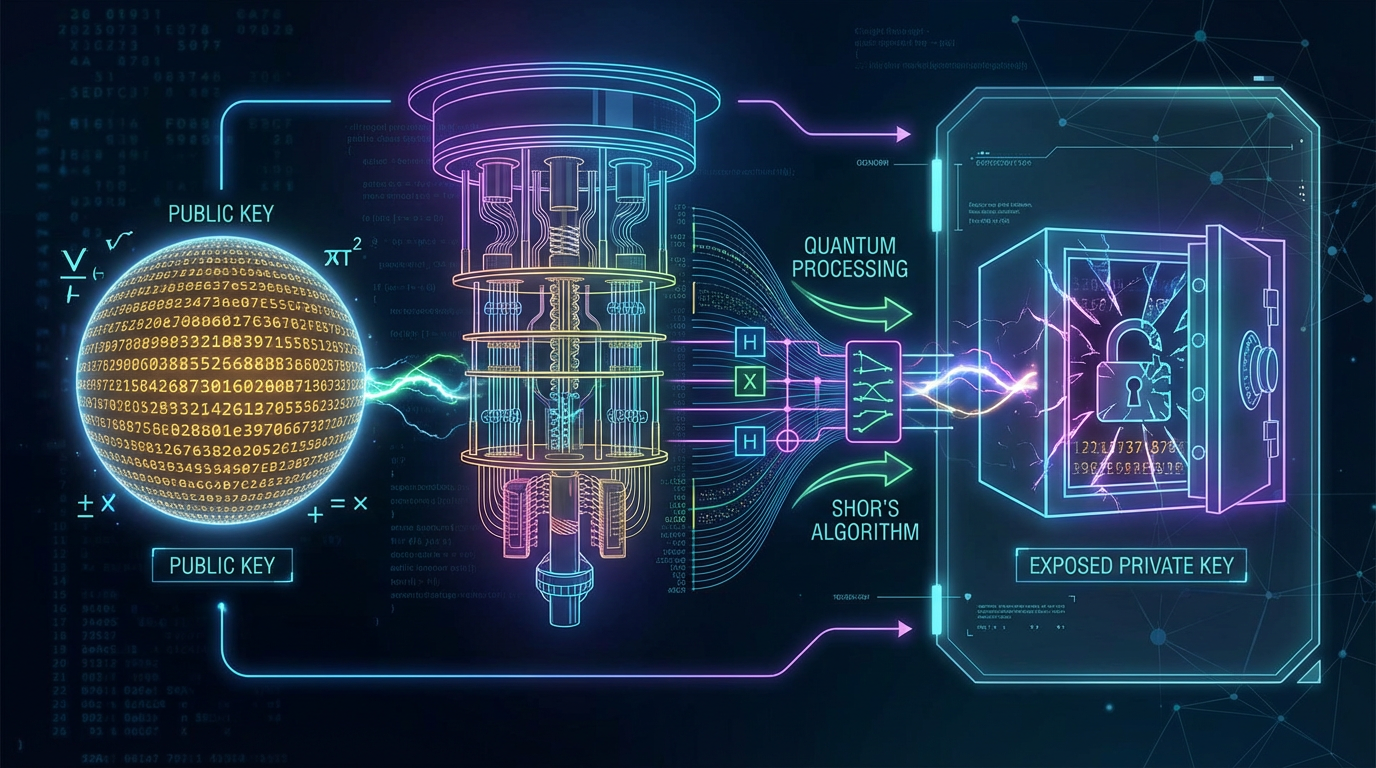
Ethereum faces the same fundamental risk. Any externally owned account (EOA) that has sent a transaction has its public key exposed. The moment Q-Day arrives, these assets become sitting ducks.
And here’s the truly insidious part: even if Q-Day is 10 years away, the threat is already here through what’s known as “harvest now, decrypt later” attacks. Sophisticated adversaries are already recording encrypted blockchain data with the intention of decrypting it once quantum computers become available. Your transactions today could be compromised tomorrow.
Expert Analysis: The Timeline and the Response
So when does Q-Day actually arrive? The consensus among experts is sobering: 5 to 15 years.
That might sound like a comfortable buffer, but in the context of blockchain governance and the time required to coordinate network-wide cryptographic migrations, it’s alarmingly short. Bitcoin’s last major protocol upgrade took years of debate and testing. Ethereum’s transition to proof-of-stake was a multi-year odyssey fraught with delays and technical challenges.
The good news is that the cryptographic community has been preparing. In August 2024, the U.S. National Institute of Standards and Technology (NIST) finalized its first three Post-Quantum Cryptography (PQC) standards:
- ML-KEM (FIPS 203): Based on CRYSTALS-Kyber, for secure key exchange
- ML-DSA (FIPS 204): Based on CRYSTALS-Dilithium, for digital signatures—the critical component for blockchain transactions
- SLH-DSA (FIPS 205): Based on SPHINCS+, a hash-based alternative for signatures
These standards provide the mathematical foundation for quantum-resistant blockchains. The challenge now is implementation.
Bitcoin and Ethereum are taking different approaches, reflecting their distinct design philosophies:
Bitcoin’s Conservative Path: The Bitcoin community is exploring a gradual, hybrid migration where users can voluntarily create new PQC-based addresses while legacy ECDSA addresses remain functional. This avoids a disruptive hard fork but creates challenges in migrating the vast number of existing UTXOs, particularly those belonging to users who have lost their private keys.
Ethereum’s Flexible Framework: Ethereum’s Account Abstraction (EIP-4337) offers a more adaptable solution. Individual accounts can function like smart contracts, defining their own signature verification logic. This means users could upgrade to PQC signatures (like ML-DSA) without requiring a consensus-level protocol change. Vitalik Buterin has outlined a multi-year roadmap for this transition, and several Ethereum Improvement Proposals are already in development.
At Savanti Investments, we’re actively modeling these migration scenarios through our SavantTrade™ platform, analyzing the market implications of different transition paths. The data suggests that Ethereum’s architectural flexibility may give it a significant advantage in executing a smoother, faster migration.
Real-World Implications: Winners, Losers, and Strategic Moves
The quantum threat isn’t just a technical problem—it’s a market-shaping force that will create clear winners and losers.
The Vulnerable:
- Early Bitcoin holders with exposed public keys face the highest risk
- Blockchains with rigid governance structures may struggle to coordinate timely upgrades
- Projects that ignore or downplay the quantum threat will lose institutional trust
- Exchanges and custodians that fail to implement PQC will become liability magnets
The Prepared:
- Blockchains that successfully migrate to PQC will gain a massive competitive advantage
- Security firms specializing in PQC implementation and auditing will see explosive demand
- Hardware wallet manufacturers that integrate quantum-resistant algorithms will capture market share
- Institutional investors will gravitate toward quantum-safe assets, creating a “flight to security”
I’ve been advising clients through Savanti Investments to start positioning for this transition now. That means:
- Inventory Your Exposure: Identify which of your holdings are in addresses with exposed public keys
- Plan Your Migration: Develop a strategy for moving assets to quantum-resistant addresses as they become available
- Diversify Across Protocols: Don’t put all your eggs in one blockchain’s migration basket—different networks will execute this transition with varying degrees of success
- Monitor Development: Stay informed about PQC implementation timelines for your holdings
- Consider Quantum-Resistant Alternatives: Emerging blockchains built from the ground up with PQC may offer lower-risk exposure
The regulatory landscape is also shifting. The U.S. government has mandated that federal agencies migrate to PQC by 2035, with high-risk systems transitioning much sooner. The European Union has published a coordinated implementation roadmap. While these regulations don’t explicitly target cryptocurrency, they set the de facto standard for what constitutes “secure” in the digital economy.
Blockchains that fail to meet these emerging standards will face increasing regulatory scrutiny and potential restrictions on institutional adoption.
Future Outlook: The Path to Quantum Resilience
Despite the gravity of the threat, I remain optimistic about the blockchain industry’s ability to adapt. Why? Because the quantum challenge is forcing a long-overdue security modernization that will ultimately make these networks stronger, more resilient, and more trustworthy.
The transition to PQC will catalyze innovation across multiple dimensions:
Protocol Evolution: The need to accommodate larger PQC signatures is driving innovations in blockchain efficiency and scalability. Ethereum’s Account Abstraction, for example, offers benefits far beyond quantum resistance—it enables more sophisticated wallet functionality, better user experience, and enhanced security features.
Cryptographic Renaissance: The development of PQC has reinvigorated cryptographic research, producing algorithms with novel properties and capabilities. This intellectual ferment will yield benefits across the entire digital security landscape.
Market Maturation: The quantum threat is separating serious, long-term blockchain projects from speculative ventures. Projects that successfully navigate this transition will emerge with enhanced credibility and institutional trust.
New Investment Opportunities: The PQC migration creates a new market for specialized security solutions, auditing services, and quantum-resistant infrastructure. At Savanti Investments, we’re actively identifying and evaluating these opportunities through our QuantAI™ research platform.
Looking ahead, I expect to see:
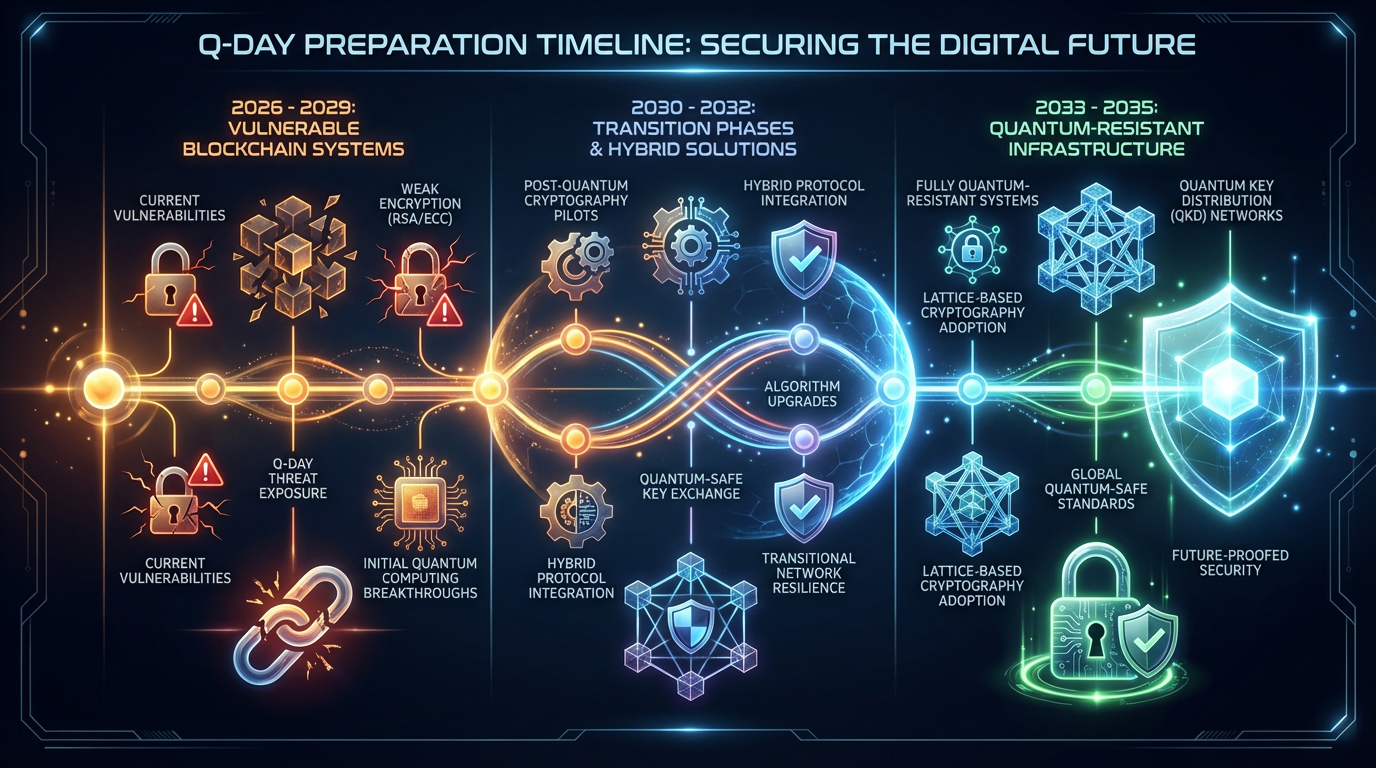
- 2026-2027: First production implementations of PQC in major blockchains; voluntary migration tools become available
- 2028-2030: Accelerated adoption as quantum computing capabilities advance; regulatory pressure intensifies
- 2031-2035: Majority of blockchain assets migrate to quantum-resistant addresses; legacy ECDSA addresses become increasingly risky
- Post-2035: Quantum-resistant cryptography becomes the baseline standard; blockchains that failed to adapt face existential crisis
The key insight is this: the quantum threat is not a reason to abandon blockchain technology—it’s a catalyst for its evolution into a more secure, robust, and future-proof foundation for the digital economy.

The Bottom Line: Act Now, Not Later
The quantum computing revolution is not a distant hypothetical. It’s happening now, accelerating faster than most people realize, and it poses a direct threat to the cryptographic foundations of blockchain technology.
But here’s what I want you to take away from this: awareness is the first step to resilience.
If you’re a cryptocurrency investor, start auditing your holdings and planning your migration strategy. If you’re a developer, familiarize yourself with NIST’s PQC standards and contribute to implementation efforts. If you’re an institution, demand quantum-resistant security from your custodians and infrastructure providers.
The blockchain industry has faced existential challenges before—from the Mt. Gox hack to the scaling debates to the regulatory crackdowns. Each time, the technology has emerged stronger and more mature. The quantum threat will be no different, but only if we act with urgency and foresight.
At Savanti Investments, we’re not just tracking this transition—we’re actively participating in it, advising clients, investing in quantum-resistant solutions, and building the analytical tools needed to navigate this new landscape. Our Convirtio platform is helping blockchain projects communicate these complex security transitions to their communities, because education and transparency will be critical to maintaining trust during this migration.
The quantum era is coming. The question isn’t whether your crypto will be safe—it’s whether you’re preparing for the transition while there’s still time.
The clock is ticking. But we still have time to act.
Disclaimer: This article is for educational and informational purposes only and does not constitute investment advice, financial advice, trading advice, or any other sort of advice. The author and Savanti Investments do not recommend that any cryptocurrency or digital asset should be bought, sold, or held by you. Conduct your own due diligence and consult your financial advisor before making any investment decisions. Cryptocurrency investments are subject to high market risk, including the risk of total loss. Past performance is not indicative of future results.
Savanti Investments, QuantAI™, SavantTrade™, and Convirtio are trademarks of Savanti Capital Management LLC. This article represents the views of the author and may not reflect the views of all Savanti Investments personnel. The information provided is believed to be accurate as of the date of publication but is subject to change without notice.
This offering is made pursuant to Regulation D, Rule 506(c) under the Securities Act of 1933. Investment opportunities discussed herein are available only to accredited investors as defined in Rule 501 of Regulation D. Prospective investors should carefully review all offering materials and consult with their legal, tax, and financial advisors before making any investment decision.