Autonomous Space Exploration: The Final Frontier for AI
When I first started working with quantitative models at Savanti Investments, I was fascinated by how autonomous systems could make split-second decisions in volatile markets—decisions that would be impossible for human traders to execute in time. Today, that same principle is being applied 250,000 miles away, where autonomous AI systems are making life-or-death decisions on the lunar surface with zero human intervention.
The convergence of artificial intelligence and space exploration isn’t just another tech trend—it’s a fundamental reimagining of how we explore the cosmos. And the implications extend far beyond space itself, offering profound lessons for anyone building autonomous systems in finance, logistics, or any domain where latency and uncertainty reign supreme.
What’s Happening: The Autonomous Space Revolution
March 2026 marks a pivotal moment in space exploration. NASA’s Artemis II mission is set to launch next month, featuring sophisticated autonomous navigation systems that will operate during its lunar flyby. But the real breakthrough isn’t the crewed mission—it’s what’s happening on the ground.
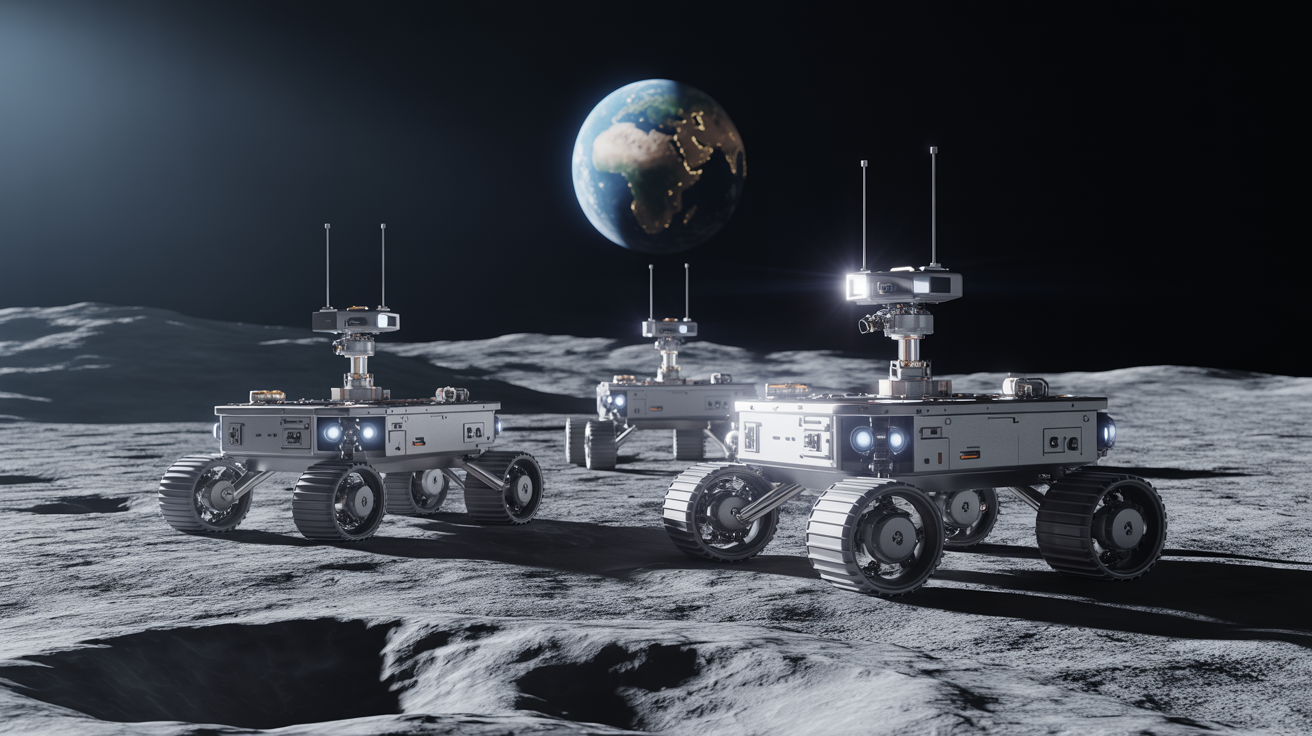
Through NASA’s Commercial Lunar Payload Services (CLPS) program, a series of robotic landers are deploying infrastructure to the Moon right now, completely autonomously. The most remarkable of these is the Cooperative Autonomous Distributed Robotic Exploration (CADRE) mission, which has deployed three suitcase-sized rovers that operate as a coordinated swarm—no human control required.

Think about that for a moment. These rovers are performing 3D terrain mapping and subsurface analysis using a distributed software framework that integrates centralized planning with autonomous execution. They’re essentially running a multi-agent system in one of the most hostile environments imaginable, with communication delays that make real-time human oversight impossible.
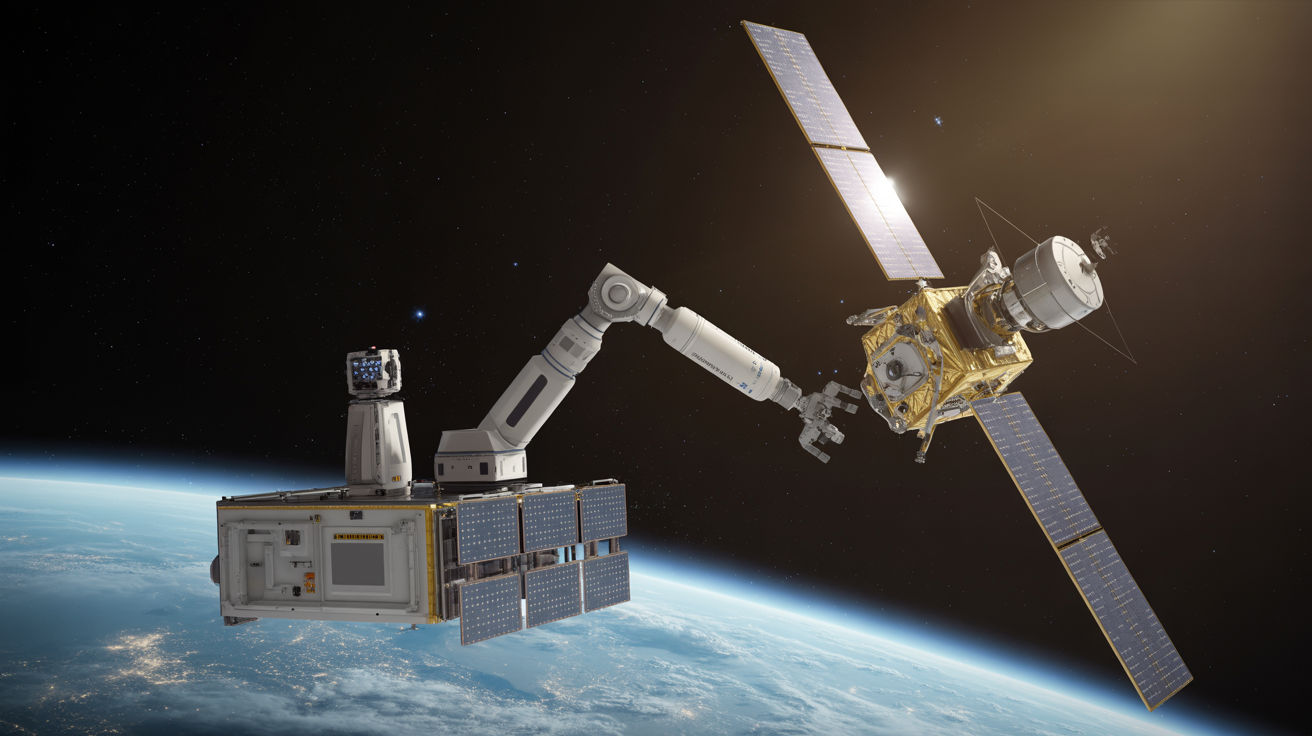
Meanwhile, in geosynchronous orbit 22,000 miles above Earth, Northrop Grumman’s Mission Robotic Vehicle (MRV) is demonstrating something equally revolutionary: autonomous satellite servicing. Equipped with a robotic arm and AI-powered vision systems, it’s repositioning satellites, performing repairs, and installing life-extension modules—all without a human hand touching the controls.
The market is responding accordingly. The global spacecraft autonomy market is projected to grow from $5.04 billion in 2025 to $10.81 billion by 2030. But these numbers barely capture the magnitude of what’s unfolding. We’re witnessing the birth of an entirely new economic sector: the on-orbit economy.
Why It Matters: The Physics of Autonomy
Here’s what most people miss about autonomous space exploration: it’s not optional. It’s a fundamental requirement imposed by the laws of physics.
When NASA’s Perseverance rover encounters an obstacle on Mars, it can’t wait for instructions from Earth. The round-trip communication delay is up to 44 minutes. By the time mission control sees the problem and sends a response, the rover could have driven off a cliff. This isn’t a technical limitation we can engineer around—it’s a hard constraint imposed by the speed of light.
This is where AI becomes not just useful, but essential. Perseverance uses Enhanced AutoNav and Terrain Relative Navigation (TRN) to make real-time driving decisions. It processes visual data through deep learning models, estimates terrain traversability, and plots safe paths—all onboard, all autonomous.
The same principle applies to the European Space Agency’s Hera mission, which uses AI for self-driving navigation toward asteroids. Like an autonomous vehicle on Earth, it must perceive its environment, make decisions, and execute maneuvers without waiting for human approval.
But here’s where it gets interesting for those of us in finance and trading: the technical challenges of autonomous space exploration are remarkably similar to the challenges we face in algorithmic trading and quantitative finance.
The Technical Frontier: Lessons for Earth-Based Systems
At Savanti Investments, our QuantAI™ platform processes market data and executes trades in microseconds. We can’t afford to wait for human approval when market conditions shift. The same is true for spacecraft operating in deep space—except their constraints are even more severe.
Consider the hardware challenge. Space-grade processors must withstand intense radiation that can cause bit-flips or catastrophic failures. Traditional radiation-hardened chips are reliable but generations behind commercial processors in performance. They simply can’t run the complex deep learning models required for autonomous navigation and decision-making.
The solution? A hybrid approach using commercial-off-the-shelf (COTS) processors—GPUs, FPGAs, and specialized AI accelerators like the Google Edge TPU—that have been rigorously tested for radiation tolerance. This offers massive performance gains while maintaining reliability. It’s a masterclass in optimizing for constraints, something every quantitative trader understands intimately.
Then there’s the data problem. Deep learning models require vast amounts of labeled training data. But for missions to unexplored environments, that data doesn’t exist. The Φ-sat-1 mission solved this by training its cloud-detection AI on augmented data from other satellites before launch—a technique analogous to transfer learning in financial modeling, where we train models on historical data and adapt them to new market regimes.
Perhaps most critically, there’s the bandwidth constraint. NASA’s Magnetosphere Multiscale mission can only transmit about 4% of the data it collects daily. The solution? Onboard AI that analyzes data in real time and prioritizes what to send back. This is edge computing at its most extreme—and it’s exactly the kind of distributed intelligence we’re building into our SavantTrade™ platform for real-time market analysis.
Real-World Implications: The On-Orbit Economy
The commercial implications of autonomous space systems extend far beyond exploration. We’re witnessing the emergence of an entirely new economic sector centered on on-orbit servicing, assembly, and manufacturing.
Astroscale’s commercial refueler, launching this year, will conduct the first-ever hydrazine refueling of a U.S. military satellite in geosynchronous orbit. The Space Force’s Tetra-5 and Kamino programs are demonstrating autonomous rendezvous, inspection, and fuel transfer capabilities. These aren’t science experiments—they’re the foundation of a multi-billion dollar industry.
The business model is compelling: extending a satellite’s operational life by five years through autonomous servicing is far more cost-effective than launching a replacement. With tens of thousands of satellites projected to be in orbit by 2030, the market for autonomous servicing, refueling, and debris removal is enormous.

But the real opportunity lies in what comes next: autonomous in-space manufacturing and assembly. When you can build and maintain infrastructure in orbit without human intervention, you unlock entirely new possibilities—from massive solar arrays to deep-space telescopes to orbital data centers.
This is where the convergence with AI becomes truly transformative. At Convirtio, we’re exploring how autonomous systems can optimize complex workflows in digital marketing. The same principles apply to orbital construction: multi-agent systems coordinating to assemble structures, AI-powered quality control, and autonomous logistics management.
Future Outlook: From Moon to Mars and Beyond
The trajectory is clear. By 2030, we’ll have over 100,000 active satellites generating petabytes of data daily. AI will be indispensable for processing this information, creating what I call a “time-to-insight” economy—where the value isn’t in collecting data, but in extracting actionable intelligence from it faster than anyone else.
This has direct parallels to financial markets. In quantitative trading, the edge goes to those who can process information and execute decisions faster than the competition. The same will be true in space: the organizations that can autonomously analyze satellite data and derive insights in real time will dominate applications from precision agriculture to climate monitoring to disaster response.
Looking further ahead, Japan’s Martian Moons eXploration (MMX) mission, launching this year, will autonomously collect samples from Phobos and return them to Earth by 2031. NASA’s Dragonfly mission, a nuclear-powered octocopter, will autonomously search for signs of life on Saturn’s moon Titan starting in 2028. These aren’t incremental improvements—they’re missions that would be impossible without autonomous AI.
But with this transformative potential comes significant risk. The convergence of AI and space creates what researchers call a “double dual-use” problem. AI systems on satellites present new vectors for cyberattacks, including adversarial machine learning where malicious inputs can trick an AI into catastrophic errors. These systems can be used for both civilian and military purposes, amplifying geopolitical tensions.
Moreover, international space law—largely based on treaties from the 1960s and 1970s—is woefully inadequate for the age of autonomous systems. Who is liable when an autonomous spacecraft makes a decision that causes damage? Who owns intellectual property for discoveries made by AI? These aren’t hypothetical questions—they’re urgent policy challenges that require international cooperation.
The Path Forward: Governance Meets Innovation
As someone who has spent years navigating the regulatory landscape of quantitative finance, I recognize the pattern. Transformative technology always outpaces governance. The question isn’t whether to regulate autonomous space systems—it’s how to create frameworks that enable innovation while managing risk.
The United Nations Office for Outer Space Affairs is recommending an international code of practice for AI in space, including standards for explainable AI, robust safeguards for autonomous decisions, and clear decision logs for accountability. This “human-on-the-loop” approach—where humans monitor but don’t directly control autonomous systems—is exactly what we implement in algorithmic trading.
We also need global cybersecurity protocols for space assets, emphasizing real-time information sharing and coordinated threat response. And critically, we need policies that promote fairness and inclusivity—ensuring that the benefits of space technology aren’t concentrated in a few nations or corporations.
The opportunity is immense. The global space economy, valued at $570 billion in 2023, is projected to reach $2 trillion by 2040. Autonomous systems will be the primary driver of that growth. But realizing this potential requires balancing innovation with responsibility—a challenge that extends far beyond space itself.
Conclusion: The Exponential Frontier
Autonomous space exploration represents more than technological achievement—it’s a proving ground for the autonomous systems that will reshape every industry on Earth. The lessons we learn from coordinating rover swarms on the Moon, servicing satellites in orbit, and navigating asteroids in deep space will directly inform how we build autonomous systems for finance, logistics, manufacturing, and beyond.
At Savanti Investments, we’re constantly asking: how do we build systems that make optimal decisions under uncertainty, with minimal latency, in environments we can’t fully predict? That’s exactly the question NASA is answering on Mars, in lunar orbit, and throughout the solar system.
The final frontier isn’t just space—it’s autonomy itself. And the organizations that master it, whether in orbit or on Earth, will define the next era of human achievement.
The future is autonomous. The question is: are you ready?